

Precedent and Stare Decisis: Why Previous Judicial Decisions Matter
Last updated on September 1, 2026
Parent Topic Guide
This analysis is part of our comprehensive reference guide on Foundations of Law.
Table of Contents

Precedent and Stare Decisis: Why Previous Judicial Decisions Matter
Why Do Previous Court Decisions Matter?
Precedent is a previous judicial decision that provides legal authority for deciding a later case involving the same or a similar legal issue. Stare decisis is the doctrine under which courts generally follow applicable precedent rather than deciding every similar case entirely from scratch.
The Latin phrase stare decisis means, roughly, “to stand by things decided.”
In a common-law legal system, previous judicial decisions can therefore become an important source of law. Courts do not simply apply statutes and constitutional provisions in isolation. They also interpret those legal sources, develop doctrines, resolve ambiguities, and establish principles that may govern future cases.
This creates an important characteristic of common-law reasoning:
Today’s judicial decision may become tomorrow’s legal authority.
The doctrine is not absolute. Courts distinguish cases whose facts or legal issues are materially different, and higher courts may overrule earlier decisions. A court may also decline to follow a precedent when the precedent is not binding, when a later authority has displaced it, or when the relevant legal framework has changed.
The practical result is a balance between continuity and development.
The law should be stable enough that people can understand and rely upon it, but flexible enough to correct mistakes and respond to changing circumstances.
What Is Precedent?
A precedent is a previous judicial decision that provides authority for deciding a subsequent case.
The important point is that not every previous case is automatically precedent for every later case.
A previous decision becomes relevant when it addresses a legal issue that is sufficiently similar to the issue before the later court.
Cornell’s Legal Information Institute explains precedent as a court decision considered authoritative for subsequent cases involving identical or similar facts or legal issues. It also emphasizes that a prior decision is precedent only with respect to issues that the court actually considered and decided.
This qualification is crucial.
A judicial opinion may contain:
- facts;
- legal questions;
- arguments from the parties;
- rules;
- reasoning;
- conclusions;
- hypothetical observations;
- and commentary on issues that were not necessary to resolve the dispute.
Not all of these components have the same precedential force.
What Is Stare Decisis?
Stare decisis is the doctrine of adhering to precedent.
When a court encounters a legal question that has already been authoritatively decided, stare decisis generally requires or strongly encourages the court to follow the earlier decision when the precedent is binding and the relevant facts and legal issues are sufficiently similar.
Cornell describes stare decisis as the doctrine that courts adhere to precedent when deciding cases, and distinguishes between vertical and horizontal stare decisis.
The distinction is fundamental.
Vertical stare decisis
A lower court follows the decisions of higher courts within the relevant judicial hierarchy.
Horizontal stare decisis
A court follows its own previous decisions, subject to the rules governing that particular court and jurisdiction.
Vertical precedent is generally the stronger form of constraint.
A federal district court, for example, cannot simply disregard a controlling decision of the U.S. Supreme Court because the district judge prefers a different interpretation.
Why Does the Legal System Follow Precedent?
At first glance, stare decisis may seem strange.
If a judge believes that an earlier case was wrongly decided, why not simply correct the mistake?
The answer lies in the broader purposes of a legal system.
A system in which every judge could freely reinvent legal doctrine would create serious problems.
People would have difficulty predicting legal consequences.
Different courts could decide essentially identical disputes differently.
Lawyers would struggle to advise clients.
Businesses would have difficulty planning.
Individuals would have difficulty organizing their affairs.
Courts would repeatedly reconsider questions that had already been resolved.
Precedent therefore promotes several important values:
- consistency;
- predictability;
- stability;
- fairness;
- efficiency;
- reliance;
- and institutional legitimacy.
Cornell’s discussion of stare decisis identifies predictability, consistency, reliance, and the integrity of the judicial process among its principal rationales.
Treating Like Cases Alike
One of the simplest justifications for precedent is equal treatment.
Suppose two people are involved in virtually identical legal situations.
If one person wins because the first judge prefers one interpretation of the law, while the second person loses because another judge prefers another interpretation, the legal system may appear arbitrary.
Precedent attempts to reduce that arbitrariness.
The underlying principle is:
Similar cases should ordinarily be decided according to the same legal principles.
This does not mean that every case with superficial similarities must receive the same result.
Legal reasoning requires attention to legally significant differences.
But it does mean that courts should not casually abandon established principles simply because a different result seems attractive in an individual case.
Predictability and Reliance
Another important justification is reliance.
People organize their conduct around the law.
A business may enter a contract because it understands the legal consequences of doing so.
A property owner may make an investment based on established property law.
A corporation may structure its affairs according to existing corporate doctrine.
A lawyer may advise a client based on established precedent.
If legal principles could change unpredictably whenever a new judge took office, the ability to rely on law would be weakened.
Stare decisis therefore contributes to the idea that law should provide a relatively stable framework within which people can make decisions.
Judicial Efficiency
Precedent also promotes efficiency.
Courts do not have unlimited time.
If every case required judges to reconsider fundamental questions that had already been decided repeatedly, litigation would become slower and more expensive.
Precedent allows courts to begin with existing legal principles.
The question becomes:
Does the existing rule apply to this case?
rather than:
What should the law be from the beginning?
This does not eliminate judicial reasoning.
In fact, applying precedent often requires sophisticated reasoning about:
- facts;
- legal principles;
- jurisdiction;
- statutory language;
- constitutional provisions;
- and the reasoning of earlier cases.
Precedent in the Common-Law Tradition
The importance of precedent is closely associated with the common-law tradition.
Common law developed historically through judicial decisions.
English courts gradually developed principles through the resolution of individual disputes.
Those principles became increasingly important as later courts looked to earlier decisions.
The American legal system inherited this tradition from English law and developed its own system of judicial precedent.
Cornell describes common law as law developed through judicial decisions rather than enacted statutes and notes that American courts developed their own doctrines through precedent and analogy to decided cases.
This does not mean that common-law systems ignore legislation.
Modern American law is a complex combination of:
- constitutional law;
- statutes;
- regulations;
- common-law doctrines;
- judicial interpretations;
- and other sources of legal authority.
The significance of precedent lies partly in the fact that courts must interpret these sources and those interpretations can themselves become authoritative.
Precedent Is Not the Same as Statutory Law
A statute and a judicial precedent are different kinds of legal authority.
A legislature enacts a statute.
A court decides a case.
For example, Congress might enact a statute prohibiting certain conduct.
A later court may be required to determine what particular statutory language means.
The court’s interpretation can become precedent for later cases.
Thus:
Legislature → statute
while:
Court → judicial decision → potentially authoritative precedent
The distinction becomes particularly important when statutory language is ambiguous or disputed.
Judicial Interpretation and Precedent
Courts frequently encounter questions that legislation does not answer explicitly.
A statute may contain words whose meaning is disputed.
It may not clearly address an unusual factual situation.
Two provisions may appear to conflict.
A court must then interpret the legal text.
Once an appellate court authoritatively resolves the question, its interpretation may become precedent.
Later courts may then rely upon that interpretation when similar questions arise.
This is one of the mechanisms through which judicial decisions contribute to the development of law.
Precedent and the Constitution
Constitutional law provides another major field in which precedent matters.
The U.S. Constitution contains broad principles and provisions.
Courts must interpret concepts such as:
- due process;
- equal protection;
- freedom of speech;
- unreasonable searches;
- federal powers;
- separation of powers;
- and other constitutional provisions.
The Supreme Court’s interpretation of those provisions becomes highly influential.
Because constitutional text is often general rather than extremely detailed, judicial precedent can play a particularly significant role in defining its application.
At the same time, constitutional precedent raises a fundamental question:
How much authority should a previous court’s interpretation possess when the Constitution itself is the ultimate source of authority?
This question has generated some of the most important debates in American jurisprudence.
The Judicial Hierarchy
To understand precedent, one must understand court hierarchy.
In the federal system, the basic structure includes:
- the U.S. Supreme Court;
- U.S. Courts of Appeals;
- U.S. District Courts;
- and specialized federal courts.
State court systems have their own hierarchies.
The authority of a judicial decision depends heavily on which court decided it.
A decision from a higher court generally has greater precedential authority over lower courts within the relevant jurisdiction.
Cornell explains that a binding precedent from an appellate court must be followed by lower courts within its jurisdiction. It also notes that U.S. Supreme Court decisions bind lower courts on questions within the Supreme Court’s authority.
Binding Precedent
Binding precedent is precedent that a court is required to follow.
For example, a federal district court must generally follow controlling decisions of the U.S. Court of Appeals governing its circuit.
It must also follow controlling decisions of the U.S. Supreme Court.
A lower court does not have the option of simply saying:
“I disagree with the Supreme Court.”
A judge may believe that the higher court’s decision is incorrect.
But judicial hierarchy determines which precedent controls.
This is one of the central institutional features of the rule of law.
Persuasive Authority
Not every judicial decision is binding.
A case may instead be persuasive authority.
Persuasive authority is material that a court may consider but is not legally required to follow.
Examples can include:
- decisions from other states;
- decisions from other federal circuits;
- lower-court decisions;
- foreign judgments;
- scholarly commentary;
- and other nonbinding legal authorities.
The value of persuasive authority can nevertheless be substantial.
A carefully reasoned decision from another jurisdiction may influence a court, particularly when the issue is novel and there is little controlling authority.
Binding Does Not Mean Identical
A common misunderstanding is that a binding precedent applies whenever the facts look similar.
That is not enough.
The court must determine whether the legal issue and legally significant facts fall within the precedent.
Two cases may involve the same general subject but produce different results because legally important facts differ.
For example, two cases may involve a property dispute, but one may concern an express easement while the other concerns adverse possession.
The subject is similar.
The legal issue is not.
Holding: What Did the Court Actually Decide?
One of the most important concepts in precedent is the holding.
The holding is the legal determination necessary to resolve the case.
Suppose a court decides that a particular contract is unenforceable because it lacks a required legal element.
The relevant holding concerns that legal issue.
The holding is different from every statement made by the judges in the opinion.
When studying precedent, therefore, one of the first questions should be:
What exactly did the court decide?
Cornell’s Wex explains that “held” in a judicial decision refers to what the court decided or ruled.
Ratio Decidendi
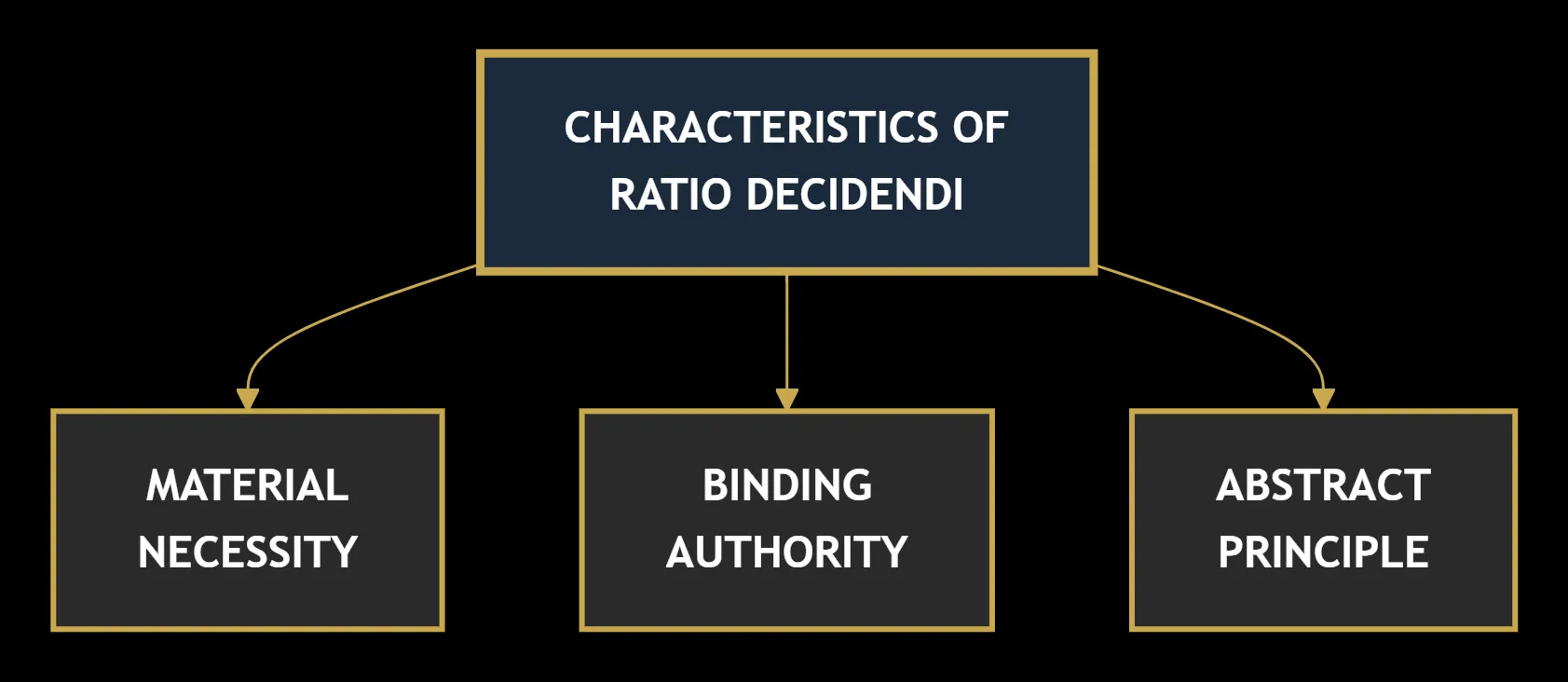
The phrase ratio decidendi comes from Latin and refers to the reasoning or legal principle necessary for the court’s decision.
It is closely associated with the idea of the rule that emerges from a case.
Suppose:
- A statute protects a particular category of conduct.
- The defendant engaged in that conduct.
- The court interprets the statute as covering the defendant.
- The court therefore rules for the defendant.
The reasoning necessary to reach the judgment forms part of the precedent.
The exact formulation of the rule may be debated, but the principle is that the precedential significance lies in what was necessary to decide the case.
Dicta: What the Court Said Beyond What Was Necessary
Dicta, short for obiter dicta, refers to statements in a judicial opinion that are not necessary to the decision.
A judge may discuss hypothetical situations.
The judge may speculate about what might happen under different circumstances.
The judge may discuss broader philosophical or legal questions.
These statements can be intellectually important and persuasive.
But they generally do not have the same binding force as the holding.
This distinction is essential when reading cases.
A long judicial opinion may contain hundreds of pages.
Only a portion may establish the binding legal rule.
Why Dicta Still Matter
It would be a mistake to conclude that dicta are worthless.
They can be highly persuasive.
A court may carefully explain how it would approach a related question even though that question is not technically necessary to the decision.
Later courts may find that reasoning convincing.
Lawyers therefore frequently cite dicta when arguing for the development or extension of legal doctrine.
The important distinction is:
Binding holding ≠ persuasive dicta.
How Courts Identify the Rule in a Previous Case
A lawyer reading a precedent should not simply search for a sentence that sounds useful.
The analysis should examine:
- the facts;
- the legal question;
- the applicable law;
- the court’s reasoning;
- the precise judgment;
- and which propositions were necessary to reach that judgment.
This is why legal education places so much emphasis on case briefing.
The goal is not merely to remember what a judge wrote.
It is to understand what legal principle the decision actually establishes.
Case Briefing and Precedent
A traditional case brief often identifies:
- Facts
- Procedural history
- Issue
- Rule
- Holding
- Reasoning
- Disposition
This structure helps separate the legally significant material from the background.
The most important question for precedent is often:
What rule did the court establish or apply in resolving the issue?
Once that is understood, the lawyer can determine whether the precedent actually governs the later case.
Applying Precedent by Analogy
Common-law reasoning often works through analogy.
A lawyer argues:
“The earlier case is sufficiently similar to this case that the same legal principle should apply.”
The opposing lawyer may respond:
“The earlier case is materially different because the relevant facts or legal issue are different.”
Both sides are reasoning from precedent.
This is why common-law legal reasoning is not merely mechanical.
The lawyer must determine which similarities and differences are legally significant.
Distinguishing Cases
A court can avoid applying an apparently relevant precedent by distinguishing the present case.
To distinguish a case means to identify a legally meaningful difference between the earlier case and the current dispute.
Cornell’s Wex defines distinguishing as recognizing a significant difference between cases and explains that parties commonly argue that such differences mean the earlier decision should not control the later case.
For example:
An earlier case may establish that a particular contractual clause is enforceable when clearly disclosed.
A later case may involve the same general clause but circumstances in which the clause was hidden, ambiguous, or presented under materially different conditions.
The later court may conclude that the precedent does not control.
This is not necessarily rejecting precedent.
It is applying precedent carefully according to its scope.
The “On All Fours” Case
Lawyers sometimes describe a previous case as being “on all fours” with the current case.
The expression means that the two cases are substantially alike in their legally significant facts and issues.
Cornell’s Wex describes “on all fours” as a metaphor for cases with substantially similar facts.
A case that is genuinely on all fours with a binding precedent presents a powerful argument for applying the same legal rule.
However, perfectly identical cases are relatively uncommon.
Legal reasoning therefore frequently concerns degrees of similarity.
Overruling Precedent
Sometimes a court does not distinguish an earlier case.
Instead, it concludes that the earlier rule should no longer govern.
This is known as overruling.
When a higher court overrules an earlier precedent, the earlier rule ceases to be controlling law to the extent of the overruling.
A famous example is:
Brown v. Board of Education
which rejected the constitutional doctrine associated with Plessy v. Ferguson concerning racial segregation in public schools.
Cornell’s Wex uses this example to illustrate the effect of overruling precedent.
Overruling demonstrates that stare decisis is not an absolute command.
Stare Decisis Is Not Absolute
A particularly important principle is that stare decisis does not mean that every previous decision must remain law forever.
Legal systems need mechanisms for correcting serious errors.
Cornell notes that the U.S. Supreme Court has described stare decisis as not an “inexorable command” and recognizes circumstances in which precedent may be abandoned, particularly where prior decisions are unworkable or badly reasoned.
The challenge is determining when correction is justified.
If courts overturn precedent too easily, legal stability suffers.
If courts never overturn precedent, legal errors may become permanently entrenched.
The doctrine therefore exists within a tension between:
stability and correction.
When Might a Court Overrule Precedent?
Several considerations can influence the decision to abandon precedent.
These may include:
- serious analytical error;
- inconsistency with constitutional text;
- inconsistency with legislation;
- unworkability;
- changed legal circumstances;
- changed factual assumptions;
- significant doctrinal development;
- serious practical problems;
- or the recognition that the precedent is fundamentally incompatible with the legal system’s governing principles.
The precise standards differ among courts and jurisdictions.
The important point is that overruling is an exceptional judicial act rather than the ordinary operation of precedent.
Vertical Stare Decisis
Vertical stare decisis concerns the relationship between higher and lower courts.
If the Supreme Court establishes a controlling constitutional rule, lower courts must generally apply it.
If a federal Court of Appeals establishes a rule binding within its circuit, district courts in that circuit generally must follow it.
This structure prevents every lower court from independently reconsidering the same legal question.
It also creates institutional consistency.
The judicial system can therefore be visualized as a hierarchy in which authoritative decisions flow downward.
Horizontal Stare Decisis
Horizontal stare decisis concerns a court’s treatment of its own previous decisions.
For example, an appellate court may ordinarily follow its own prior decisions.
The Supreme Court also generally treats its previous decisions as important precedents.
But the degree of constraint can differ depending on the court and jurisdiction.
Horizontal stare decisis is therefore not simply another name for vertical precedent.
It addresses a different institutional relationship.
The Supreme Court and Its Own Precedent
The U.S. Supreme Court is not formally unable to change its own doctrine.
It has overruled previous Supreme Court decisions many times.
But the Court generally treats precedent as an important consideration.
This reflects the institutional costs of changing established law.
When the Court changes a major constitutional doctrine, the consequences can extend far beyond the immediate parties.
It may affect:
- government institutions;
- businesses;
- individuals;
- state courts;
- federal courts;
- administrative agencies;
- and future litigation.
The doctrine of stare decisis therefore has particular importance at the highest level of judicial authority.
Precedent and Statutory Law
Statutes can change the effect of precedent.
Suppose a court develops a common-law rule.
The legislature later passes a statute addressing the same subject.
The statute may:
- codify the judicial rule;
- modify it;
- replace it;
- or create exceptions.
Cornell notes that legislatures sometimes codify common-law doctrines and may also modify or replace judicially developed rules through legislation.
This illustrates an important principle:
Judicial precedent exists within a larger constitutional and legislative framework.
Courts do not possess unlimited authority to create law independently of higher sources of law.
Precedent and Constitutional Supremacy
The Constitution occupies a special position in the hierarchy of U.S. law.
A judicial precedent cannot legitimately override the Constitution itself.
Courts interpret the Constitution, but the Constitution remains the higher legal authority.
This creates an important distinction between:
the Constitution
and
judicial interpretations of the Constitution.
The two are closely connected but not identical.
Judicial precedent can change.
Constitutional text can be formally amended through the constitutional amendment process.
This distinction is central to debates over judicial interpretation.
Precedent and Federalism
The American system contains both federal and state courts.
This creates a complex network of precedent.
A decision by one state’s highest court may bind courts within that state.
It generally does not bind courts in another state.
Similarly, a federal Court of Appeals generally establishes binding precedent within its circuit but not in another circuit.
This produces the possibility of circuit splits.
Circuit Splits
A circuit split occurs when different federal appellate courts reach conflicting conclusions about the same legal issue.
For example:
- the Fifth Circuit may adopt one interpretation;
- the Ninth Circuit may adopt another.
Neither circuit ordinarily controls the other.
The disagreement may continue until the Supreme Court resolves the issue, Congress changes the law, or another legal development resolves the conflict.
Circuit splits are important because they demonstrate that precedent is not a single universal hierarchy.
Its authority depends upon:
- jurisdiction;
- court level;
- subject matter;
- and the path of appellate review.
State Precedent and Federal Courts
Federal courts sometimes have to interpret state law.
In such circumstances, a federal court may need to determine what the relevant state’s highest court has decided.
A federal court cannot simply create its own preferred version of state law when controlling state authority exists.
This illustrates a broader principle:
The authority of precedent depends on the legal question being decided as well as the court that issued the earlier decision.
Persuasive Precedent From Other Jurisdictions
A decision from another jurisdiction can nevertheless be extremely useful.
Suppose a state supreme court has never considered a particular issue.
A lawyer may look to decisions from:
- other states;
- federal courts;
- foreign common-law jurisdictions;
- or other respected authorities.
Those decisions may be persuasive.
The court is free to consider their reasoning without being legally compelled to follow them.
This is especially important in emerging areas of law.
Precedent and Novel Legal Questions
What happens when no controlling precedent exists?
The court must reason from other legal sources.
It may consider:
- constitutional text;
- statutes;
- regulations;
- existing judicial decisions;
- common-law principles;
- legal history;
- precedent from other jurisdictions;
- policy considerations;
- and established principles of statutory or constitutional interpretation.
The court may then establish a new rule.
That decision can itself become precedent for future cases.
This is one of the mechanisms through which common law develops.
The Development of Common Law
Common law can therefore evolve incrementally.
A court decides Case A.
A later court encounters Case B.
The facts are similar but not identical.
The court determines how the existing rule applies.
Another case follows.
Over time, a body of doctrine develops.
This process is sometimes described as case-by-case development.
It contrasts with the idea of a comprehensive legal code in which every legal rule is intended to be stated in advance.
Modern legal systems often combine both approaches.
Precedent and Judicial Lawmaking
Does precedent mean that judges “make law”?
This is a complicated jurisprudential question.
One view emphasizes that judges primarily interpret and apply existing law.
Another recognizes that judicial decisions can create new legal rules, particularly when no statute or previous case directly resolves the issue.
The common-law tradition has long accepted some degree of judicial development.
But judicial lawmaking is constrained by:
- constitutional structure;
- statutes;
- precedent;
- institutional jurisdiction;
- procedural limitations;
- and the requirement that courts decide actual cases and controversies.
The debate over judicial lawmaking is therefore not simply about whether judges make law.
It is about the legitimate boundaries of judicial authority.
Precedent and the Rule of Law
Stare decisis has a close relationship with the rule of law.
The rule of law requires legal institutions to operate according to established principles rather than arbitrary personal preferences.
If judges could freely disregard earlier decisions whenever convenient, similar cases might receive inconsistent treatment.
Precedent therefore contributes to institutional discipline.
But the rule of law also requires that erroneous or unjust rules can eventually be corrected.
The challenge is to preserve both:
continuity
and
legal development.
Precedent and Judicial Impartiality
Precedent can also reduce the influence of personal preference.
A judge may have a particular philosophical or political view.
But if controlling precedent dictates a particular result, the judge’s personal preference cannot simply replace the governing law.
This reinforces the idea that judges are applying a legal system rather than exercising unrestricted personal discretion.
Of course, judges still exercise judgment in determining:
- the scope of precedent;
- factual similarity;
- statutory meaning;
- constitutional principles;
- and whether a precedent applies.
Precedent therefore constrains judicial discretion without eliminating it.
The Problem of Bad Precedent
The existence of precedent creates a difficult question:
What should happen when the precedent itself is wrong?
There are several possibilities.
A court may:
- apply the precedent;
- distinguish it;
- narrow its scope;
- interpret it in light of later authority;
- decline to follow it because it is not binding;
- or, where the court has authority, overrule it.
The choice depends on the judicial hierarchy and the nature of the precedent.
This is one reason legal reasoning cannot be reduced to simply “find a case and copy its answer.”
Precedent and Legal Change
Legal systems must change.
New technologies create new legal problems.
Social practices change.
Economic structures evolve.
Legislatures enact new laws.
Constitutions are amended.
New factual circumstances emerge.
A rigid system in which precedent could never change would become increasingly disconnected from society.
At the same time, constant doctrinal change would undermine predictability.
Stare decisis therefore functions as a stabilizing principle within a changing legal system.
A Famous Example: Brown and Plessy
Few examples illustrate the complexity of precedent better than the relationship between:
Plessy v. Ferguson
and
Brown v. Board of Education.
Plessy had accepted the constitutional doctrine commonly described as “separate but equal.”
Decades later, Brown rejected the constitutional validity of racial segregation in public schools.
Brown therefore did not merely decide a new factual dispute.
It rejected an established constitutional precedent.
The episode demonstrates two apparently conflicting truths:
Precedent creates stability.
But:
precedent cannot guarantee that an established legal rule will remain forever.
A legal system must retain some capacity for fundamental correction.
Precedent and Social Legitimacy
The legitimacy of precedent depends partly on the public perception that courts are applying law rather than simply imposing personal preferences.
A stable body of precedent can increase confidence in judicial institutions.
But a precedent perceived as profoundly unjust can undermine confidence.
This creates a difficult institutional problem.
Courts must balance:
- fidelity to law;
- respect for precedent;
- institutional stability;
- justice;
- constitutional principles;
- and public legitimacy.
There is no mechanical formula that resolves every conflict.
How Lawyers Use Precedent
Legal research often begins with identifying the relevant legal issue.
The lawyer then searches for:
- controlling precedent;
- relevant statutory provisions;
- constitutional authority;
- persuasive precedent;
- cases interpreting similar language;
- cases with similar facts;
- later cases modifying the earlier rule.
The lawyer must then determine the current status of the precedent.
A case that appears highly relevant may have been:
- overruled;
- superseded by statute;
- limited by a later decision;
- distinguished;
- criticized;
- or otherwise weakened.
This is why simply finding an old case is not enough.
How to Read a Precedent
When reading a judicial decision, begin with the following questions.
What happened?
Identify the material facts.
What legal question was before the court?
This is the issue.
What law governed?
Identify statutes, constitutional provisions, regulations, and earlier cases.
What did the court decide?
Find the holding.
Why did the court decide it?
Study the reasoning.
Which statements were necessary?
These are central to identifying the precedent.
Which statements were unnecessary?
These may constitute dicta.
What court issued the decision?
This determines much of its authority.
Is the decision still good law?
Check subsequent cases and legislation.
Does the current case actually fall within the precedent?
Compare the legally significant facts and issues.
This is the foundation of case-law analysis.
A Practical Example
Imagine that Court A decides:
A landlord may be liable for a dangerous condition on leased premises under specified circumstances.
Later, Court B receives a case involving a different type of property and a different relationship between the parties.
The plaintiff argues:
“Court A established the rule that landlords are liable.”
The defendant responds:
“Court A’s rule applied only where the landlord had particular knowledge and control.”
The court must therefore examine the earlier decision carefully.
What was its holding?
What facts mattered?
What legal principle was necessary?
Were the differences between the cases legally significant?
This is precedent analysis.
Precedent Is About Principles, Not Just Outcomes
A common mistake is to focus only on who won the earlier case.
Suppose the plaintiff won.
That does not mean:
“Plaintiffs always win cases like this.”
The important question is:
Why did the plaintiff win?
Perhaps the plaintiff won because:
- a statute applied;
- a contractual clause was invalid;
- a constitutional right was violated;
- negligence was established;
- a procedural requirement was satisfied;
- or a particular exception did not apply.
The legal principle behind the result is what matters.
Precedent and Facts
Facts are extraordinarily important in common-law reasoning.
A judicial rule is often shaped by the factual circumstances in which it was developed.
This means that lawyers must identify:
- which facts were legally significant;
- which facts were incidental;
- which facts triggered the rule;
- and which facts distinguish the current case.
This is why reading only the final paragraph of a judicial opinion is rarely sufficient.
The reasoning matters.
Precedent and Legal Interpretation
Precedent can also influence how courts interpret words.
Suppose a statute uses the word “reasonable.”
Different cases may gradually explain what “reasonable” means in particular contexts.
Over time, a body of precedent develops.
The statutory word remains the same.
But its judicial interpretation becomes more precise.
This is one way in which precedent gives practical meaning to general legal language.
The Relationship Between Precedent and Legal Principles
Precedent is not simply a collection of isolated cases.
Cases contribute to broader legal principles.
For example, hundreds of decisions may contribute to the development of doctrines concerning:
- negligence;
- contract interpretation;
- property;
- fiduciary duties;
- constitutional rights;
- criminal procedure;
- administrative law.
A lawyer therefore studies both individual cases and the doctrinal structure that connects them.
Precedent and Legal Certainty
A functioning legal system needs a degree of certainty.
People should be able to answer questions such as:
- What does this contract mean?
- Can this conduct result in liability?
- What rights does a property owner have?
- What procedures must government follow?
- What constitutional protections apply?
Precedent helps answer these questions by providing accumulated judicial interpretations.
But certainty is always relative.
New factual situations can generate new questions.
The law is therefore better understood as a developing system of principles rather than a perfectly complete collection of predetermined answers.
The Limits of Precedent
Precedent has important limits.
A previous case may not apply because:
- the court lacked authority over the present court;
- the legal issue is different;
- the facts are materially different;
- the case was overruled;
- legislation changed the governing rule;
- the precedent was limited by later decisions;
- or the earlier statement was merely dicta.
Therefore, the existence of a precedent does not end legal analysis.
It begins it.
Precedent Versus Analogy
There is also an important difference between following precedent and reasoning by analogy.
Following binding precedent means the court is required to apply the controlling legal rule.
Reasoning by analogy means the court considers another case because its reasoning appears relevant even though the earlier case may not technically control.
Analogy is especially important where:
- the issue is novel;
- there is no binding precedent;
- or persuasive authority from another jurisdiction provides useful reasoning.
Precedent Versus Stare Decisis
The terms are closely related but not identical.
Precedent refers to the previous judicial decision that may provide authority.
Stare decisis refers to the doctrine or principle of adhering to applicable precedent.
In simple terms:
Precedent is the earlier decision.
Stare decisis is the principle of following it when appropriate.
The distinction is useful when discussing judicial reasoning.
Precedent and the Architecture of the Legal System
Precedent connects several parts of the legal system.
Constitution
provides foundational legal authority.
Legislature
creates statutes.
Agencies
create regulations under delegated authority.
Courts
interpret and apply those sources.
Judicial decisions
may establish precedent.
Later courts
apply, distinguish, limit, or sometimes overrule that precedent.
The result is a dynamic legal system in which different institutions contribute to the development and interpretation of law.
Why Stare Decisis Matters Beyond the Courts
The effects of precedent extend beyond litigation.
Businesses use precedent to assess legal risk.
Lawyers use it to advise clients.
Government agencies use it when interpreting their authority.
Individuals use it, often indirectly, when deciding how to behave.
Legislatures may draft statutes in response to judicial decisions.
Thus, precedent influences the behavior of society even when no one is currently standing before a judge.
The Philosophical Question: Why Should the Past Bind the Present?
At its deepest level, stare decisis raises a philosophical problem.
Why should a judge today be constrained by the reasoning of a judge from yesterday?
The answer cannot simply be:
“Because the earlier judge said so.”
That would make the doctrine circular.
The stronger justification is institutional.
The legal system values:
- consistency;
- predictability;
- fairness;
- reliance;
- legitimacy;
- and continuity.
A precedent is therefore followed not necessarily because the earlier judge was infallible, but because a legal system must have mechanisms for maintaining continuity over time.
The doctrine recognizes that the law belongs to an institution, not merely to the individual judge deciding today’s case.
Edmund Burke and the Idea of Institutional Continuity
The philosophical idea of respecting inherited institutions has a long history.
Edmund Burke emphasized the importance of continuity between generations and warned against treating society as something that could simply be redesigned from first principles at every moment.
Although Burke was not developing the modern doctrine of stare decisis in the technical legal sense, his broader philosophy helps illuminate one justification for precedent.
Law is partly an accumulated institutional inheritance.
Each generation receives legal principles from previous generations, modifies them, and passes them forward.
Precedent and the Living Legal Order
At the same time, a legal system cannot exist entirely in the past.
The meaning and application of legal rules can evolve.
New technology creates questions about privacy.
New commercial structures create questions about liability.
New forms of communication create questions about speech.
New scientific knowledge can alter the factual assumptions underlying legal doctrines.
Precedent must therefore operate within a living legal order.
The challenge is not choosing between absolute stability and unlimited change.
It is finding a principled way to change law without destroying legal continuity.
The Golden Balance
Stare decisis can therefore be understood as a balance between two dangers.
Too little adherence to precedent
If every judge freely changes legal rules:
- law becomes unpredictable;
- similar cases may receive different treatment;
- reliance becomes difficult;
- litigation becomes more expensive;
- and judicial discretion may become excessive.
Too much adherence to precedent
If no precedent can ever be reconsidered:
- legal errors become entrenched;
- outdated doctrines survive indefinitely;
- unjust rules may become permanent;
- and law may become disconnected from constitutional or legislative developments.
The mature operation of stare decisis lies between these extremes.
Key Takeaways
- Precedent is a previous judicial decision that may provide authority for deciding a later case.
- Stare decisis is the doctrine of adhering to applicable precedent.
- Stare decisis means approximately “to stand by things decided.”
- Precedent is particularly important in common-law systems.
- Not every previous judicial decision is binding precedent.
- Binding precedent must generally be followed by courts subject to the relevant judicial hierarchy.
- Persuasive authority may influence a court but does not legally compel it.
- Vertical stare decisis concerns following decisions of higher courts.
- Horizontal stare decisis concerns following a court’s own prior decisions.
- The holding is the court’s decision on the legal issue necessary to resolve the case.
- Dicta are statements that are not necessary to the decision and generally have less precedential force.
- Lawyers analyze precedent by examining facts, issues, rules, reasoning, holdings, and subsequent treatment.
- Courts can distinguish a precedent when materially different facts or legal issues mean that the earlier rule does not control.
- A precedent can sometimes be overruled by a court with appropriate authority.
- Statutes can codify, modify, or replace common-law rules.
- Constitutional authority occupies a superior position to ordinary judicial precedent.
- Federalism creates different layers of precedent among federal and state courts.
- A decision from another jurisdiction may be persuasive without being binding.
- Precedent promotes consistency, predictability, reliance, fairness, and judicial efficiency.
- Stare decisis is not absolute; legal systems must retain a mechanism for correcting serious errors.
- The central practical question when reading a case is not simply “Who won?” but “What legal rule explains why they won?”
- Precedent is best understood as part of a continuing process in which courts apply, interpret, distinguish, develop, limit, and sometimes overrule legal principles.
Frequently Asked Questions
What is precedent in law?
Precedent is a previous judicial decision that provides legal authority for deciding a later case involving a sufficiently similar legal issue or legally significant facts.
What does stare decisis mean?
Stare decisis is Latin for “to stand by things decided.” It describes the doctrine under which courts generally follow applicable judicial precedent.
Is every court decision a precedent?
No. A decision may lack precedential authority because of the court that issued it, the nature of the decision, jurisdictional rules, or because the relevant statements were not necessary to the judgment.
What is binding precedent?
Binding precedent is a judicial rule or principle that a court is legally required to follow because it comes from an authoritative court within the relevant judicial hierarchy.
What is persuasive precedent?
Persuasive precedent is a judicial decision that a court may consider but is not required to follow. Decisions from other jurisdictions are common examples.
What is vertical stare decisis?
Vertical stare decisis requires lower courts to follow controlling decisions of higher courts within the applicable judicial system.
What is horizontal stare decisis?
Horizontal stare decisis concerns a court’s adherence to its own previous decisions.
What is the holding of a case?
The holding is the court’s determination of the legal issue necessary to resolve the case.
What is dicta?
Dicta, or obiter dicta, are statements in a judicial opinion that are not necessary to the judgment. They can be persuasive but generally do not have the same binding force as the holding.
What does it mean to distinguish a case?
To distinguish a case means to identify a legally significant difference between the earlier case and the current case so that the earlier precedent does not control the new dispute.
What does it mean to overrule a precedent?
Overruling occurs when a court with appropriate authority rejects an earlier judicial rule so that the earlier decision is no longer controlling precedent on the relevant issue.
Can the Supreme Court overrule its own precedent?
Yes. The Supreme Court generally treats its own precedent as highly important, but it is not absolutely prohibited from overruling earlier decisions.
Can Congress overturn a Supreme Court decision?
Congress cannot simply reverse a constitutional interpretation of the Supreme Court through ordinary legislation. However, Congress can change statutory law within its constitutional authority, meaning that a judicial interpretation of a statute can sometimes be superseded by subsequent legislation.
Can a state court ignore a federal Supreme Court precedent?
A state court cannot disregard controlling U.S. Supreme Court precedent on questions of federal law or the U.S. Constitution.
Is a decision from another state binding?
Generally, no. A decision from another state’s courts may be persuasive but ordinarily does not bind courts in a different state.
What is a circuit split?
A circuit split occurs when different federal Courts of Appeals reach conflicting conclusions about the same legal issue.
Why is precedent important in common-law systems?
Precedent allows courts to develop legal principles incrementally through judicial decisions while promoting consistency and predictability.
Is precedent the same thing as case law?
Not exactly. Case law generally refers to law developed through judicial decisions or the body of judicial decisions on a subject. Precedent refers more specifically to a prior decision that provides authority for deciding a later case.
Is precedent stronger than a statute?
No. A valid statute generally has authority over conflicting ordinary common-law precedent. Courts interpret statutes, but they do not ordinarily have authority to disregard valid legislation simply because they prefer an earlier judicial rule.
Is precedent stronger than the Constitution?
No. The Constitution is superior to ordinary judicial precedent. Judicial decisions interpreting the Constitution are authoritative, but the Constitution itself remains the higher legal source.
Why do courts follow precedent if judges can make mistakes?
Because a legal system values stability, consistency, predictability, reliance, and equal treatment. Stare decisis also provides mechanisms through which serious mistakes can eventually be corrected.
Does stare decisis prevent legal change?
No. It makes legal change more structured and deliberate. Courts can distinguish, narrow, reconsider, or overrule precedent in appropriate circumstances, while legislatures can change statutory law.
What is the easiest way to understand a precedent?
Ask five questions:
What happened?
What legal issue did the court decide?
What rule did it establish or apply?
Why did that rule produce the result?
Does the current case involve the same legally significant issue and facts?
Those questions reveal whether a previous decision actually matters to the present dispute.
Further Reading
For readers who want a reliable legal reference for the concepts discussed in this article, the Legal Information Institute at Cornell Law School provides accessible explanations of precedent, stare decisis, binding precedent, case law, and related concepts.
The information provided in this article ("Precedent and Stare Decisis: Why Previous Judicial Decisions Matter") is for general educational and informational purposes only and does not constitute formal legal advice. Reading this content does not create an attorney-client relationship. Laws vary by jurisdiction; consult a licensed attorney for specific legal matters.

Tsvety, LL.M., M.A.
Today’s Quiz
Criminal Procedure
10 real questions, free, no account needed. See how well you actually know criminal procedure.
Free This Week
Open this week’s Legal Concept Presentation
A downloadable, branded slide deck explaining one key legal term in depth — free every week, the full library included with All-Access.

Interactive Legal Suite
Advance Your Legal Analysis
Explore our interactive decision trees, litigation pipeline builders, and procedural court simulators — designed specifically for law students and practitioners.
Access Interactive Tools →Enjoy The Law To Know?
Tell Google you’d like to see more from us in Search and AI Overviews.
Start small
Try us for a few dollars, or for nothing. No account needed for the first three.
- Free rights card Free
Five sentences to show the police if you are arrested abroad, in many languages.
A whole chapter of black-letter law on one printable page. Free sample.
Inheritance, marriage, children and property in one European country, in one PDF.
72 editable templates: leases, wills, agreements, notices and more.
- Pocket guides $12
Short PDF reference books with closed-book self-checks.
Discussion
Log in to join the discussion.
No comments yet — be the first to add to the discussion.