

The Major Branches of Law: An Organized Map of the Entire Legal Field
Last updated on September 1, 2026
Parent Topic Guide
This analysis is part of our comprehensive reference guide on Foundations of Law.

Major Branches of Law: A Complete Guide to the Structure of the Legal System
Law is an enormous field. It governs the relationship between individuals, businesses, governments, institutions, and, increasingly, activities that cross national borders. Because the body of law is so extensive, lawyers, judges, academics, and students divide it into branches or areas of law.
The major branches of law include constitutional law, administrative law, criminal law, contract law, tort law, property law, family law, commercial and corporate law, employment law, intellectual property law, tax law, procedural law, evidence law, bankruptcy law, environmental law, and international law, among others.
These branches are not completely separate compartments. They overlap constantly. A business dispute may involve contract, corporate, property, tax, employment, and intellectual property law at the same time. A criminal investigation may raise constitutional, criminal-procedure, evidence, and privacy questions. A dispute involving an environmental permit may combine administrative, environmental, property, constitutional, and statutory law.
There is also more than one way to classify law. One of the oldest distinctions divides law into public law and private law. Another distinguishes substantive law from procedural law. Other classifications distinguish domestic law from international law, civil law from criminal law, or statutory law from common law.
Understanding these classifications is important because the branches of law are not simply a list to memorize. They are different ways of organizing the legal system according to what law regulates, whom it regulates, what kind of legal relationship is involved, what rights and duties exist, and how those rights and duties are enforced.
What Are the Major Branches of Law?
The major branches of law are broad fields into which legal rules, doctrines, institutions, and disputes are organized.
At the broadest level, lawyers commonly distinguish between:
- Public law, which concerns government, public authority, and the relationship between the state and individuals;
- Private law, which primarily governs legal relationships among private persons and organizations;
- Substantive law, which establishes rights, duties, liabilities, offenses, and legal relationships;
- Procedural law, which establishes the methods by which legal rights and obligations are enforced and disputes are resolved;
- Domestic law, which governs matters within a particular state or jurisdiction;
- International law, which governs certain relationships and activities that cross national boundaries.
These categories overlap.
For example, criminal law is substantive public law, while criminal procedure is procedural law. Contract law is generally considered private substantive law, while civil procedure provides the procedural mechanism through which a contract claim may be litigated. The distinction between substantive and procedural law is important but not always perfectly clear. U.S. courts themselves have recognized that the boundary can be difficult to draw.
The first important lesson is therefore:
There is no single flat list of legal branches. Law has an architecture.
Why Do We Divide Law Into Branches?
The division of law into branches is partly practical and partly intellectual.
A modern legal system contains an enormous number of rules.
Without classification, it would be difficult to study, administer, research, or practice law.
Imagine trying to treat the following as one undifferentiated subject:
- the power of Congress;
- murder;
- divorce;
- ownership of land;
- breach of contract;
- patents;
- corporate mergers;
- environmental permits;
- bankruptcy;
- taxation;
- international treaties;
- and the rules governing a civil trial.
They are all law, but they address fundamentally different questions.
Classification allows us to ask:
What kind of legal relationship or problem are we dealing with?
That question points us toward the relevant branch.
The First Major Division: Public Law and Private Law
One of the oldest and most influential classifications divides law into public law and private law.
The distinction can be traced back to Roman law, particularly the work associated with the jurist Ulpian, who distinguished ius publicum from ius privatum.
The basic idea has survived for centuries:
Public law concerns the state, government, public authority, and matters affecting the public legal order.
Private law concerns legal relationships among private persons.
The distinction is useful, but it is not absolute.
Modern legal fields frequently cross the boundary.
For example, employment law may govern private relationships between employers and employees while also being heavily regulated by public legislation. Family law can involve private relationships but also substantial governmental intervention. Environmental law can regulate private property while pursuing public objectives.
So public and private law should be understood as organizing concepts rather than airtight compartments.
Public Law
Public law concerns the organization and exercise of governmental authority and the relationship between individuals and the state.
Its principal branches include:
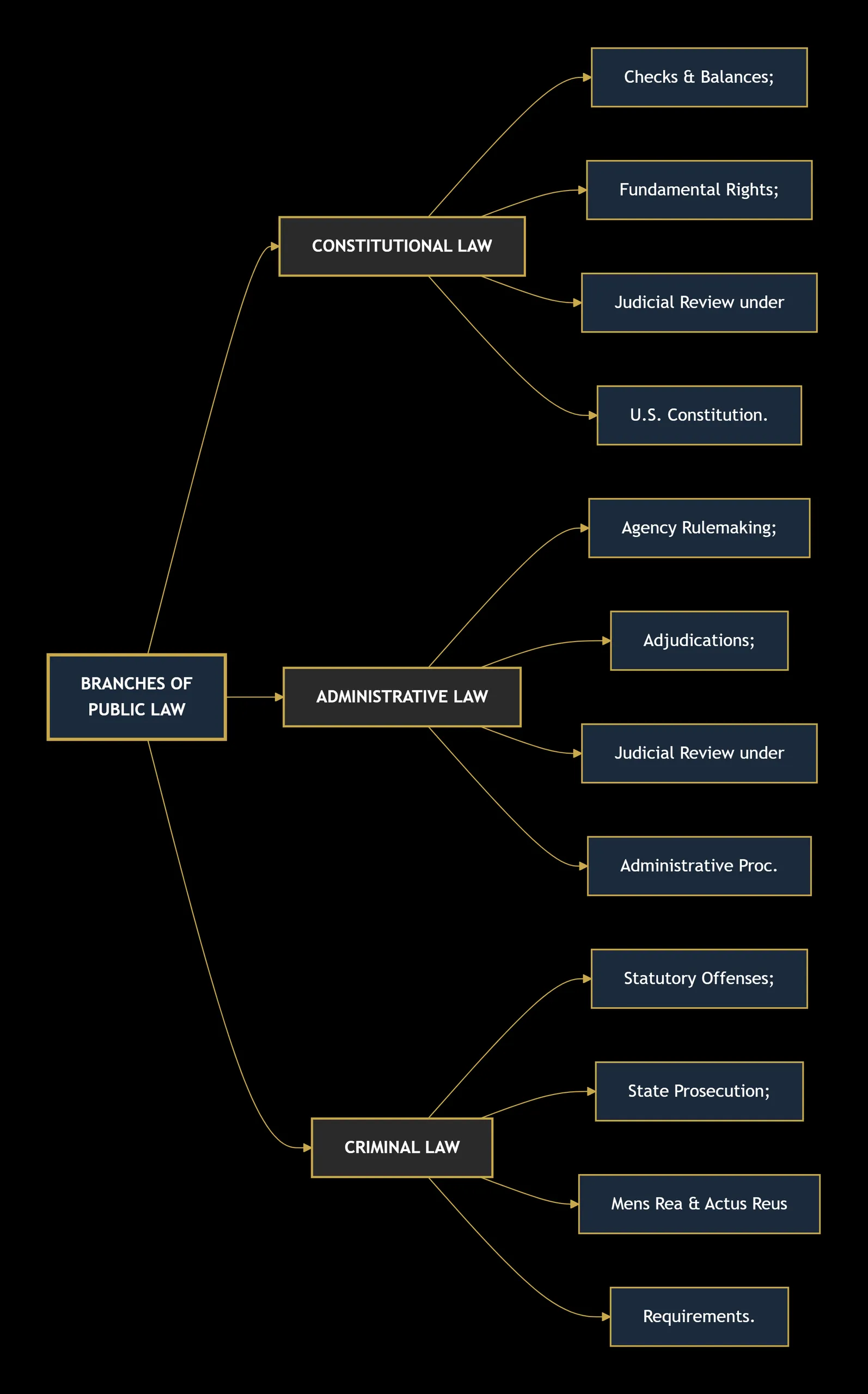
- constitutional law;
- administrative law;
- criminal law;
- tax and revenue law;
- public international law;
- and, depending on the classification, other areas involving substantial governmental authority.
The central question of public law is often:
How may public power be created, exercised, limited, and challenged?
Constitutional Law
Constitutional law is the foundational branch of public law.
It concerns the structure of government, the distribution and limitation of governmental power, constitutional rights, and the relationship between citizens and the state.
In the United States, constitutional law centers on the U.S. Constitution and its interpretation by the courts.
The Constitution establishes the federal government’s institutional structure, including the legislative, executive, and judicial branches, and establishes limits on governmental authority. Article I establishes Congress, Article II establishes the executive branch, and Article III establishes the federal judiciary.
Constitutional law therefore addresses questions such as:
- What powers does Congress possess?
- What powers belong to the President?
- What authority do federal courts possess?
- What rights are protected by the Constitution?
- What limits apply to government searches?
- What restrictions apply to governmental regulation of speech?
- How does federal power interact with state power?
- When may a court invalidate governmental action?
- What is the scope of judicial review?
- How are constitutional amendments adopted?
Constitutional law is therefore concerned not simply with individual rights but with the architecture of government itself.
Major subjects within constitutional law
Constitutional law includes:
- separation of powers;
- checks and balances;
- federalism;
- judicial review;
- constitutional interpretation;
- due process;
- equal protection;
- freedom of speech;
- freedom of religion;
- privacy and liberty interests;
- voting rights;
- constitutional limitations on government;
- and the relationship between federal and state authority.
Constitutional law provides the framework within which many other branches operate.
Administrative Law
Administrative law concerns the creation, operation, authority, and review of administrative agencies and governmental decision-making.
Administrative agencies perform enormous amounts of modern governmental work.
They may:
- issue regulations;
- grant licenses;
- conduct investigations;
- enforce statutes;
- adjudicate certain disputes;
- impose administrative penalties;
- establish technical standards;
- and administer public programs.
Administrative law therefore sits at the intersection of legislation, executive government, and judicial review.
In the United States, administrative agencies are generally created through statutes that establish their authority and responsibilities.
Administrative law asks questions such as:
- Does an agency possess the authority to act?
- Did it follow the required procedure?
- Is its decision supported by law?
- Did it exceed its statutory authority?
- What procedures must the agency follow?
- When may a court review agency action?
- What remedies are available against unlawful administrative action?
Administrative law has become particularly important because modern governments cannot directly administer every technical aspect of society through legislatures alone.
Criminal Law
Criminal law defines conduct that the state considers sufficiently harmful or wrongful to justify public punishment.
It establishes:
- criminal offenses;
- elements of offenses;
- defenses;
- principles of criminal responsibility;
- and punishments.
Examples include:
- murder;
- robbery;
- burglary;
- assault;
- fraud;
- theft;
- bribery;
- conspiracy;
- certain forms of cybercrime;
- and many regulatory offenses.
Criminal law is primarily public law because criminal prosecution is generally brought by the government.
In the federal system, for example, the government initiates criminal prosecutions, and the burden of proving guilt rests on the prosecution.
Criminal law therefore involves a fundamentally different relationship from an ordinary private lawsuit.
In a civil case, one private party may sue another for compensation or another remedy.
In a criminal case, the state prosecutes an accused person because the alleged conduct is treated as an offense against the public legal order.
Criminal law commonly addresses
- actus reus;
- mens rea;
- causation;
- attempt;
- conspiracy;
- complicity;
- defenses;
- justification;
- excuse;
- homicide;
- property offenses;
- offenses against persons;
- offenses against government;
- financial crimes;
- organized crime;
- cybercrime;
- and sentencing.
Criminal law is closely connected with criminal procedure, which determines how criminal investigations and prosecutions are conducted.
Criminal Procedure
Criminal procedure is the procedural framework surrounding criminal cases.
It governs matters such as:
- investigation;
- arrest;
- warrants;
- charging;
- indictment;
- arraignment;
- bail and pretrial detention;
- discovery;
- motions;
- trial;
- sentencing;
- appeals;
- and post-conviction proceedings.
It is therefore a good example of the difference between substantive and procedural law.
Criminal law tells us what conduct constitutes an offense.
Criminal procedure tells us how the criminal justice system processes allegations of that conduct.
The distinction is fundamental.
Private Law
Private law primarily governs relationships among private persons and organizations.
Its major traditional branches include:
- contract law;
- tort law;
- property law;
- family law;
- trusts and estates;
- commercial law;
- and related fields.
The central concept is generally private legal relationships and private rights.
But “private” does not mean “unregulated by government.”
Private relationships are often heavily regulated by statutes and administrative rules.
For example, a contract between two private businesses may be governed not only by common-law contract doctrine but also by consumer-protection legislation, tax law, employment rules, securities regulations, or commercial statutes.
Contract Law
Contract law governs legally enforceable agreements.
It answers questions such as:
- Was a contract formed?
- Was there an offer?
- Was there acceptance?
- Was consideration required and present?
- Did the parties have capacity?
- Did they intend legal consequences?
- Are the terms sufficiently certain?
- Was there fraud, mistake, duress, or undue influence?
- Was the contract breached?
- What remedies are available?
Contract law is one of the central branches of private law because agreements organize an enormous amount of economic and personal activity.
Businesses use contracts to:
- purchase goods;
- provide services;
- employ workers;
- license intellectual property;
- finance transactions;
- lease property;
- distribute products;
- acquire companies;
- and allocate risks.
Contract law therefore provides a legal infrastructure for voluntary exchange.
It is closely related to:
- commercial law;
- sales law;
- employment law;
- corporate law;
- insurance law;
- intellectual property;
- property law;
- and remedies.
Tort Law
Tort law governs civil wrongs that cause legally recognized injury or harm.
A tort can arise from an act or omission that gives rise to civil liability. Major categories include negligence, intentional torts, and strict liability.
Common tort claims include:
- negligence;
- battery;
- assault;
- false imprisonment;
- trespass;
- defamation;
- fraud;
- nuisance;
- product liability;
- and wrongful death.
Tort law serves several purposes.
It can:
- compensate injured persons;
- allocate losses;
- deter harmful conduct;
- protect legally recognized interests;
- and establish standards of reasonable behavior.
Tort law therefore occupies an important position between private rights and broader social policy.
Property Law
Property law governs legally recognized interests in things and resources.
It addresses questions such as:
- Who owns property?
- What rights accompany ownership?
- How can property be transferred?
- What rights can others have in property?
- What is possession?
- What is a lease?
- What constitutes trespass?
- How are mortgages created and enforced?
- What happens when ownership is disputed?
Property law includes both real property and personal property.
Real property
Real property generally concerns land and interests associated with land.
It includes subjects such as:
- ownership;
- estates in land;
- leases;
- easements;
- mortgages;
- covenants;
- adverse possession;
- and land-use restrictions.
Personal property
Personal property generally concerns property other than land.
It includes:
- goods;
- personal possessions;
- certain financial interests;
- and other forms of legally recognized property.
Property law intersects with contract, tort, constitutional law, taxation, environmental law, and commercial law.
Family Law
Family law regulates legal relationships arising from family and domestic life.
It commonly includes:
- marriage;
- divorce;
- legal separation;
- child custody;
- child support;
- spousal support;
- adoption;
- parental rights;
- guardianship;
- domestic relations;
- and, in some jurisdictions, reproductive and family-status issues.
Family law occupies an interesting position between public and private law.
Family relationships are fundamentally personal and private, yet the state has historically exercised substantial authority over:
- marriage;
- divorce;
- parenthood;
- child welfare;
- adoption;
- and financial obligations following family breakdown.
Family law therefore demonstrates why the public/private distinction is useful but imperfect.
Trusts and Estates Law
Trusts and estates law concerns the creation, management, transfer, and distribution of property.
It includes:
- wills;
- intestacy;
- probate;
- trusts;
- fiduciary duties;
- estate administration;
- inheritance;
- beneficiaries;
- executors;
- trustees;
- and disputes over estates.
Trust law is particularly important because it separates legal control of property from beneficial interests in ways that can serve:
- family planning;
- asset management;
- charitable purposes;
- succession planning;
- and commercial purposes.
Trusts and estates also demonstrate the historical influence of equity on modern private law.
Commercial Law
Commercial law governs business transactions and commercial relationships.
It is not always a single coherent branch.
Rather, it is a broad field incorporating several areas, including:
- sales;
- secured transactions;
- negotiable instruments;
- commercial paper;
- banking;
- finance;
- distribution;
- agency;
- insurance;
- business organizations;
- and commercial contracts.
Commercial law is particularly important because modern economies depend upon large networks of transactions between businesses.
In the United States, the Uniform Commercial Code (UCC) provides an important framework for numerous commercial transactions, although it operates through state enactments rather than as one single federal commercial code.
Corporate Law and Business Organizations
Corporate law concerns the legal structure and governance of corporations.
It addresses:
- incorporation;
- corporate personality;
- limited liability;
- directors;
- officers;
- shareholders;
- fiduciary duties;
- corporate governance;
- mergers;
- acquisitions;
- shareholder rights;
- corporate finance;
- dissolution;
- and derivative litigation.
The central legal idea is that a corporation is a distinct legal person.
This allows the corporation to:
- own property;
- enter contracts;
- sue and be sued;
- incur debts;
- employ people;
- and continue independently of changes in its shareholders.
Corporate law intersects heavily with:
- contract law;
- securities law;
- tax law;
- employment law;
- bankruptcy;
- intellectual property;
- and tort law.
Agency Law
Agency law governs relationships in which one person or entity acts on behalf of another.
The basic relationship involves:
principal → agent → third party
Agency law determines when an agent has authority to act for a principal and when the principal becomes legally bound by the agent’s conduct.
It addresses:
- actual authority;
- apparent authority;
- fiduciary duties;
- agency relationships;
- liability;
- and termination of agency.
Agency principles are fundamental to business law because corporations and other organizations must act through human representatives.
Employment and Labor Law
Employment law governs relationships between employers and employees.
It includes subjects such as:
- employment contracts;
- wages;
- working hours;
- workplace discrimination;
- harassment;
- workplace safety;
- employee classification;
- termination;
- benefits;
- leave;
- and employment disputes.
Labor law, more specifically, often concerns collective relationships involving:
- labor unions;
- collective bargaining;
- strikes;
- unfair labor practices;
- and employer-union relations.
Employment law is a good example of a hybrid field.
It governs private relationships but is heavily shaped by public regulation.
Intellectual Property Law
Intellectual property law protects legally recognized interests in creations of the mind and certain forms of commercial identity.
Its principal branches include:
Copyright
Protects qualifying original works such as:
- books;
- music;
- films;
- photographs;
- software;
- and other creative works.
Patent law
Protects qualifying inventions and technological innovations.
Trademark law
Protects marks and identifiers that distinguish goods or services.
Trade secret law
Protects qualifying confidential business information.
Intellectual property law sits at the intersection of:
- property;
- contract;
- commerce;
- technology;
- constitutional law;
- international law;
- and competition policy.
It is increasingly important in a knowledge-based economy.
Tax Law
Tax law governs the government’s authority to impose and collect taxes.
It includes:
- income taxation;
- corporate taxation;
- sales and use taxes;
- property taxation;
- estate and gift taxes;
- payroll taxation;
- international taxation;
- tax procedure;
- and tax enforcement.
Tax law is heavily statutory and regulatory.
It also raises profound constitutional questions concerning governmental power and taxation.
Tax law frequently intersects with:
- corporate law;
- property law;
- trusts and estates;
- employment;
- bankruptcy;
- and international law.
Bankruptcy and Insolvency Law
Bankruptcy law governs situations in which individuals or businesses cannot satisfy their financial obligations under ordinary circumstances.
It establishes legal mechanisms for:
- liquidation;
- reorganization;
- restructuring;
- creditor claims;
- debtor protections;
- distribution of assets;
- and discharge of certain debts.
Bankruptcy law attempts to balance competing interests.
The debtor may need protection from overwhelming debt.
Creditors have legitimate interests in recovering what they are owed.
The legal system therefore creates structured procedures for resolving financial distress.
Bankruptcy is deeply connected with:
- contract law;
- secured transactions;
- property;
- corporate law;
- tax;
- and commercial law.
Securities Law
Securities law governs the issuance, trading, disclosure, and regulation of financial instruments such as stocks and other securities.
It addresses:
- securities offerings;
- disclosure;
- registration;
- insider trading;
- market manipulation;
- broker-dealer regulation;
- investment advisers;
- shareholder information;
- and securities fraud.
Securities law is heavily regulated by federal legislation and administrative agencies in the United States, particularly the Securities and Exchange Commission.
It combines elements of:
- corporate law;
- administrative law;
- commercial law;
- criminal law;
- and civil litigation.
Environmental Law
Environmental law governs the relationship between human activity, government regulation, property, and the natural environment.
It includes:
- pollution control;
- air quality;
- water regulation;
- hazardous substances;
- waste;
- land use;
- environmental impact assessment;
- conservation;
- endangered species;
- energy regulation;
- and climate-related regulation.
Environmental law is inherently interdisciplinary.
It may involve:
- administrative law;
- constitutional law;
- property law;
- tort law;
- criminal law;
- corporate law;
- and international law.
Health and Medical Law
Health law governs legal relationships within healthcare and medicine.
It can include:
- patient rights;
- informed consent;
- medical malpractice;
- professional licensing;
- healthcare regulation;
- privacy;
- public health;
- pharmaceuticals;
- medical research;
- insurance;
- reproductive healthcare;
- and bioethics.
Medical malpractice, for example, may involve tort law.
Healthcare licensing involves administrative law.
Patient privacy can involve statutory and constitutional principles.
Public-health regulation can involve substantial governmental authority.
This illustrates again that legal branches overlap.
Immigration and Nationality Law
Immigration and nationality law governs who may enter, remain in, or become a citizen of a country.
It includes:
- visas;
- admission;
- removal;
- asylum;
- citizenship;
- naturalization;
- refugee protection;
- employment authorization;
- and immigration enforcement.
In the United States, immigration law is predominantly federal.
It combines:
- statutory law;
- administrative law;
- constitutional principles;
- international obligations;
- and judicial review.
Evidence Law
Evidence law governs what information may be presented to a court and how it may be used.
It addresses questions such as:
- Is evidence relevant?
- Is it admissible?
- Is it hearsay?
- Does an exclusionary rule apply?
- Can a witness testify about the matter?
- Is expert testimony reliable?
- Has a privilege been invoked?
Evidence law is neither purely substantive nor merely a branch of private law.
It is fundamentally connected to adjudication.
Its purpose is to help courts determine facts through legally controlled procedures.
In federal courts, the Federal Rules of Evidence provide a major framework for evidentiary questions.
Civil Procedure
Civil procedure establishes the rules governing civil litigation.
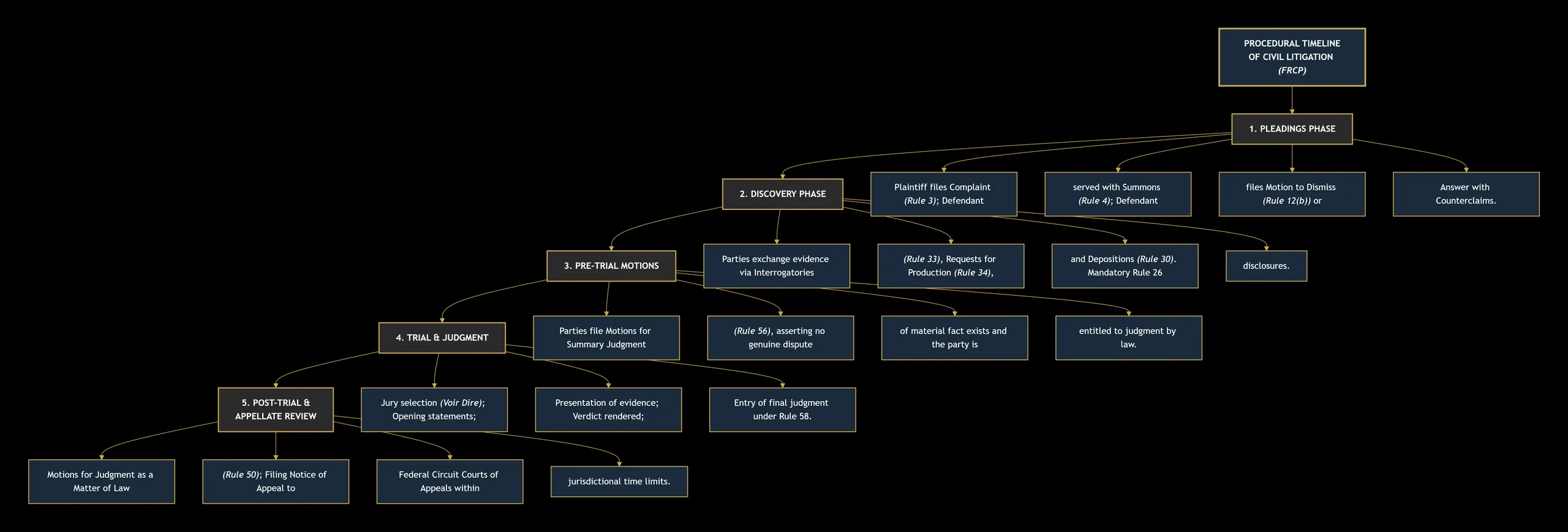
It includes:
- jurisdiction;
- pleadings;
- service;
- motions;
- discovery;
- joinder;
- class actions;
- summary judgment;
- trial;
- judgments;
- appeals;
- and enforcement.
The Federal Rules of Civil Procedure provide the principal procedural framework for civil actions in U.S. federal district courts.
Civil procedure is therefore not primarily concerned with what substantive rights people possess.
Instead, it concerns how those rights are asserted, defended, adjudicated, and enforced.
Remedies Law
Remedies law concerns what courts can do when a legal right has been violated.
Possible remedies include:
- damages;
- injunctions;
- restitution;
- specific performance;
- declaratory judgments;
- rescission;
- and other forms of relief.
Remedies are important because a legal right without an effective means of enforcement may have limited practical value.
For example:
A contract may create a right.
Contract remedies determine what happens when that right is breached.
A property right may be invaded.
Property and tort remedies determine what relief is available.
A constitutional right may be violated.
Constitutional and statutory remedies determine what judicial relief may be available.
Substantive Law and Procedural Law
This is one of the most important classifications in legal education.
Substantive law
Substantive law establishes legal rights, duties, obligations, liabilities, and prohibitions.
Examples include:
- the elements of negligence;
- the requirements for contract formation;
- the definition of murder;
- the rights associated with property ownership.
Procedural law
Procedural law establishes the methods through which legal rights and obligations are adjudicated and enforced.
It includes:
- pleading;
- discovery;
- evidence;
- motions;
- trials;
- appeals;
- and other procedural mechanisms.
The distinction is fundamental but not always perfectly clear.
The U.S. legal system has repeatedly confronted difficult questions about whether a particular rule is substantive or procedural.
This distinction can have very practical consequences.
Under the Erie doctrine, for example, federal courts exercising diversity jurisdiction generally apply state substantive law while applying applicable federal procedural rules.
Civil Law and Criminal Law
Another fundamental distinction separates civil law from criminal law.
Here, “civil law” must be distinguished from the civil-law legal tradition.
In one sense, civil law means the body of law governing non-criminal relationships and disputes.
In another sense, “civil law” refers to an entire legal tradition based historically on Roman law and characterized by extensive codification.
Those are different uses of the same phrase.
Civil law as a field
Civil law generally concerns disputes involving private rights and obligations.
Examples include:
- contract disputes;
- negligence;
- property disputes;
- family matters;
- commercial disputes.
Criminal law
Criminal law concerns offenses prosecuted by the government.
The consequences can include:
- imprisonment;
- fines;
- probation;
- restitution;
- and other criminal sanctions.
The distinction is therefore not simply about seriousness.
It concerns the nature of the legal wrong, who brings the case, the legal process, the burden of proof, and the available consequences.
Domestic Law and International Law
Law can also be classified according to geographical and sovereign scope.
Domestic law
Domestic law governs matters within a particular legal jurisdiction.
In the United States, this includes:
- federal law;
- state law;
- and local law.
Federal and state law may both regulate the same broad subject, subject to constitutional allocation of authority and federal preemption principles.
International law
International law governs legal relationships involving states, international organizations, and, in some contexts, individuals and private entities.
International law includes:
- public international law;
- private international law;
- treaty law;
- customary international law;
- international human rights law;
- international humanitarian law;
- international trade law;
- international criminal law;
- and the law of the sea.
Public International Law
Public international law governs relationships among states and other subjects recognized by international law.
It includes:
- treaties;
- diplomatic relations;
- international organizations;
- use of force;
- international humanitarian law;
- international human rights law;
- state responsibility;
- jurisdiction;
- and international dispute resolution.
International law differs structurally from domestic law because there is no single global legislature equivalent to a national parliament.
Its sources and institutions are therefore distinctive.
Private International Law
Private international law, often called conflict of laws, addresses private disputes involving more than one legal system.
For example:
A contract might be between:
- a company in New York;
- a company in London;
- with performance in Germany;
- involving goods shipped through Singapore.
Which country’s law applies?
Which court has jurisdiction?
Will a judgment from one country be recognized in another?
These are questions of private international law.
It therefore operates as a bridge between domestic legal systems.
International Criminal Law
International criminal law concerns individual responsibility for certain offenses recognized as crimes under international law.
It is associated with offenses such as:
- genocide;
- crimes against humanity;
- war crimes;
- and aggression.
It occupies an unusual position because it combines concepts from:
- criminal law;
- international law;
- humanitarian law;
- human rights;
- and international institutions.
Maritime and Admiralty Law
Maritime law governs legal relationships connected with navigation, shipping, vessels, and maritime commerce.
It can include:
- shipping;
- maritime contracts;
- cargo;
- marine insurance;
- collisions;
- salvage;
- seafarers;
- maritime liens;
- and jurisdiction over vessels.
In the United States, federal courts have a special constitutional and statutory relationship with admiralty jurisdiction.
The subject illustrates how particular industries can develop highly specialized bodies of law.
Military Law
Military law governs members of armed forces and military institutions.
It can address:
- military discipline;
- courts-martial;
- offenses under military law;
- command authority;
- military justice;
- and service-member rights.
Military law operates within constitutional and statutory constraints and has its own procedural institutions.
Energy and Natural Resources Law
Energy and natural resources law regulates the extraction, production, distribution, ownership, and use of natural resources.
It can encompass:
- oil and gas;
- electricity;
- renewable energy;
- mining;
- water;
- public lands;
- mineral rights;
- pipelines;
- and environmental regulation.
This is another hybrid field combining:
- property;
- administrative;
- environmental;
- commercial;
- tax;
- constitutional;
- and international law.
Technology and Cyber Law
Technology law is not necessarily one traditional branch in the same sense as contract or property law.
It is better understood as an interdisciplinary field.
It can involve:
- privacy;
- cybersecurity;
- intellectual property;
- contracts;
- telecommunications;
- consumer protection;
- criminal law;
- administrative regulation;
- artificial intelligence;
- data protection;
- and platform regulation.
Technology repeatedly creates circumstances in which existing legal categories must be applied to new forms of conduct.
The emergence of artificial intelligence is a particularly important example.
Questions concerning AI can simultaneously involve:
- copyright;
- contract;
- privacy;
- discrimination;
- product liability;
- intellectual property;
- administrative law;
- consumer protection;
- and constitutional questions.
Media and Communications Law
Media and communications law concerns legal relationships involving:
- publishing;
- broadcasting;
- telecommunications;
- journalism;
- digital platforms;
- advertising;
- speech;
- privacy;
- defamation;
- and intellectual property.
It has particularly strong constitutional dimensions in the United States because freedom of speech and freedom of the press are protected by the First Amendment.
At the same time, private disputes involving defamation or copyright may be governed primarily by civil law.
Consumer Protection Law
Consumer protection law regulates transactions between businesses and consumers.
It can address:
- deceptive advertising;
- unfair business practices;
- product safety;
- consumer contracts;
- warranties;
- financial products;
- privacy;
- and debt collection.
Consumer protection demonstrates the interaction between public and private law.
A consumer may have a private cause of action.
At the same time, a government agency may investigate or prosecute the same conduct.
Competition and Antitrust Law
Antitrust or competition law regulates market power and certain forms of anti-competitive conduct.
It addresses:
- monopolization;
- price fixing;
- market allocation;
- mergers;
- cartels;
- and other practices that may harm competition.
Antitrust law combines:
- statutory law;
- economic analysis;
- administrative enforcement;
- civil litigation;
- and sometimes criminal prosecution.
It is therefore another field that does not fit neatly into a single traditional category.
How the Branches of Law Interact
One of the most important things to understand is that real legal problems rarely belong to one branch only.
Consider a fictional company developing an artificial-intelligence medical device.
A single dispute might involve:
Corporate law — Who owns the company?
Contract law — What agreements exist with developers and hospitals?
Intellectual property law — Who owns the software and inventions?
Patent law — Is the technology patentable?
Employment law — What obligations exist toward employees?
Medical law — What standards govern the device?
Administrative law — Which government agency regulates it?
Product liability — Who is responsible if the device causes injury?
Privacy law — How is patient data handled?
Criminal law — Was any conduct fraudulent or otherwise criminal?
Tax law — What tax consequences arise?
International law — What happens if the device is sold internationally?
The branches of law therefore resemble overlapping fields of expertise rather than isolated rooms.
Cross-Cutting Legal Fields
Some areas of law are particularly difficult to classify because they operate across several branches.
These include:
- evidence;
- remedies;
- legal ethics;
- jurisprudence;
- comparative law;
- conflict of laws;
- regulatory law;
- human rights;
- technology law;
- environmental law;
- and legal procedure.
These fields often provide methods or frameworks that operate across substantive areas.
For example, evidence law can arise in:
- criminal cases;
- contract litigation;
- tort cases;
- family proceedings;
- commercial disputes;
- and administrative proceedings.
Similarly, remedies can arise whenever a legal right has allegedly been violated.
Legal Ethics and Professional Responsibility
Lawyers themselves are subject to professional regulation.
Legal ethics governs:
- duties to clients;
- confidentiality;
- conflicts of interest;
- competence;
- communication;
- candor toward tribunals;
- handling client property;
- fees;
- and professional misconduct.
Professional responsibility is therefore different from substantive branches such as contract or property law.
It regulates the profession through which the legal system operates.
Jurisprudence and Legal Theory
Jurisprudence is the philosophical and theoretical study of law.
It asks questions such as:
- What is law?
- Why is law binding?
- What is justice?
- What is the relationship between law and morality?
- What makes a legal rule valid?
- How should judges interpret law?
- What is a legal right?
- What is punishment?
- What is the rule of law?
Major traditions include:
- natural law;
- legal positivism;
- legal realism;
- interpretivism;
- critical legal studies;
- feminist legal theory;
- law and economics;
- and sociological approaches to law.
Jurisprudence does not usually constitute a branch of law in the same practical sense as contract or criminal law.
It is instead a way of thinking about law itself.
Comparative Law
Comparative law studies differences and similarities among legal systems.
It may compare:
- common-law systems;
- civil-law systems;
- religious legal systems;
- customary legal systems;
- mixed systems;
- constitutional structures;
- judicial institutions;
- property systems;
- contract doctrines;
- or criminal justice systems.
Comparative law is especially important in a global economy.
It allows lawyers and scholars to understand that legal categories which seem obvious in one jurisdiction may be organized very differently elsewhere.
For example, contract and tort are often distinct subjects in common-law systems, while civil-law systems may organize many obligations under broader codified categories.
Common Law and Civil Law Traditions
The phrase common law can itself have more than one meaning.
It can refer to:
- a legal tradition developed historically through judicial decisions and precedent; or
- law developed through judicial decisions as distinct from statutes or regulations.
The United States belongs broadly to the common-law tradition, although its legal system contains enormous amounts of statutory and regulatory law.
A common-law system relies significantly on judicial decisions and precedent.
A civil-law legal system, by contrast, historically places greater structural emphasis on comprehensive written codes and legislation.
This does not mean that judges in civil-law systems never interpret law or that judges in common-law systems ignore statutes.
The difference is one of legal tradition and institutional structure, not a simplistic opposition between “written law” and “judge-made law.”
Why the Classification of Law Is Not Universal
One of the most important cautions for anyone studying legal branches is this:
There is no universally accepted master taxonomy of law.
Different jurisdictions organize legal subjects differently.
Different universities organize their curricula differently.
Different law firms organize their practices differently.
Different legal scholars may use different classifications.
For example:
- one system may treat commercial law as a separate major branch;
- another may place it within civil law;
- one system may have a highly developed administrative-law structure;
- another may organize administrative disputes differently;
- one legal tradition may treat trusts as a major independent subject;
- another may incorporate similar concepts into property or obligations.
Even within the United States, the boundaries between legal fields can be porous.
The purpose of classification is therefore organization and understanding, not the creation of immutable natural categories.
The Traditional Core Subjects
Despite these differences, several fields are consistently treated as central subjects in legal education and legal practice.
A useful core includes:
Public law
- Constitutional law
- Administrative law
- Criminal law
Private law
- Contract law
- Tort law
- Property law
- Family law
- Trusts and estates
- Commercial law
- Corporate and business law
Legal process
- Civil procedure
- Criminal procedure
- Evidence
- Remedies
Specialized and regulatory fields
- Tax law
- Employment law
- Intellectual property
- Bankruptcy
- Securities
- Environmental law
- Health law
- Immigration law
- Antitrust law
International law
- Public international law
- Private international law
- International human rights law
- International humanitarian law
- International criminal law
- International trade law
This is not an exhaustive list.
It is a map of the major terrain.
A Better Way to Understand the Branches
Rather than memorizing dozens of names, it is more useful to ask four questions.
1. Who are the legal actors?
Are they:
- government and citizen?
- private individuals?
- businesses?
- employers and employees?
- corporations and shareholders?
- states?
- international organizations?
2. What relationship is being regulated?
Is it:
- governmental authority?
- ownership?
- agreement?
- injury?
- family relationship?
- employment?
- commercial exchange?
- international interaction?
3. What kind of legal rule is involved?
Is it:
- substantive?
- procedural?
- constitutional?
- statutory?
- regulatory?
- judicial?
4. What happens when the rule is violated?
Is the consequence:
- criminal punishment?
- damages?
- injunction?
- restitution?
- administrative penalty?
- loss of a license?
- invalidation of governmental action?
- or another remedy?
These questions often reveal the relevant branches more effectively than memorization alone.
A Single Legal Problem Can Belong to Several Branches
Consider a person who purchases a defective automobile.
The problem may involve:
Contract law — Was the sales agreement breached?
Tort law — Did the defect cause personal injury?
Product liability — Is the manufacturer legally responsible?
Consumer protection law — Was the buyer deceived?
Property law — What ownership rights exist?
Insurance law — Does an insurer cover the loss?
Civil procedure — Which court can hear the case?
Evidence law — What evidence establishes the defect?
Remedies law — Should the buyer receive damages, replacement, or another remedy?
This is how law operates in reality.
The branches are analytical tools, not walls.
The Relationship Between Rights and Procedure
There is another important lesson hidden in the classification of law.
A substantive right is only part of the legal system.
Suppose the law says:
“A person has a right to compensation for a particular injury.”
That tells us something important.
But we still need to know:
- Where must the claim be filed?
- What is the statute of limitations?
- What must the complaint contain?
- Who bears the burden of proof?
- What evidence is admissible?
- Can the defendant seek summary judgment?
- How is judgment enforced?
Those questions belong largely to procedure and evidence.
The substantive and procedural dimensions therefore work together.
As the Federal Courts explain, civil litigation involves formal processes beginning with a complaint and continuing through service, discovery, motions, trial, and possible relief.
The Branches of Law as an Interconnected System
A useful way to understand the entire discipline is to think in terms of four dimensions.
Government
Constitutional and administrative law explain how public authority operates.
Private relationships
Contract, tort, property, family, commercial, and corporate law regulate relationships among private actors.
Enforcement
Criminal law, civil procedure, criminal procedure, evidence, and remedies determine how legal rules are enforced.
Cross-border and specialized regulation
International, tax, environmental, technology, intellectual property, securities, immigration, and other specialized fields regulate increasingly complex areas of modern life.
These dimensions constantly intersect.
Why Law Keeps Developing New Branches
Legal classification changes because society changes.
Traditional legal systems could not have contained modern fields such as:
- cyber law;
- artificial-intelligence regulation;
- data protection;
- biotechnology law;
- space law;
- modern securities regulation;
- or complex international trade law in their present forms.
New technologies and institutions create new legal problems.
Sometimes an existing branch adapts.
Sometimes a specialized field develops.
This is how legal disciplines evolve.
A new field does not necessarily mean that entirely new legal principles have appeared.
Often it means that existing principles are being applied to a new environment.
Technology and the Future of Legal Classification
Artificial intelligence demonstrates this process particularly well.
Consider a dispute involving an AI-generated work.
It might raise:
- copyright;
- contract;
- intellectual property;
- privacy;
- consumer protection;
- employment;
- tort;
- constitutional;
- and regulatory questions.
Calling this simply “AI law” does not eliminate the underlying branches.
Instead, AI becomes a cross-cutting subject that brings several traditional branches together.
The same is true of:
- climate law;
- biotechnology;
- digital assets;
- autonomous vehicles;
- online platforms;
- cybersecurity;
- and space activity.
Modern law is therefore becoming increasingly interconnected.
The Deeper Meaning of Legal Classification
The classification of law is not merely an academic exercise.
It reveals how society understands legal relationships.
Contract law reflects the importance of voluntary agreement.
Property law reflects ideas about ownership, control, and resources.
Tort law reflects ideas about responsibility and compensation.
Criminal law reflects judgments about public wrongs and punishment.
Constitutional law reflects principles concerning governmental legitimacy and limits on power.
Administrative law reflects the reality of the modern regulatory state.
Family law reflects legal ideas about family relationships and personal status.
International law reflects the attempt to create legal order beyond the boundaries of individual states.
The branches therefore correspond, at least partly, to fundamental problems of human social organization.
From Roman Law to Modern Legal Branches
The modern classification of law has deep historical roots.
Roman jurists distinguished public and private law.
Medieval legal traditions developed elaborate systems of canon law, Roman law, customary law, and royal law.
The development of the common law produced doctrines through judicial decisions and precedent.
The rise of the modern state produced increasingly extensive legislation and administrative regulation.
The nineteenth and twentieth centuries saw enormous growth in:
- commercial law;
- corporate law;
- labor law;
- administrative law;
- taxation;
- social welfare legislation;
- environmental regulation;
- and international law.
The result is the highly differentiated legal landscape we have today.
The branches of law are therefore historical products as much as analytical categories.
Law Is a System, Not a Dictionary
The most important lesson is perhaps the simplest.
A student encountering law for the first time may imagine that legal education consists of learning thousands of definitions:
contract means this;
tort means that;
property means something else.
But legal knowledge is not primarily a dictionary.
It is a system of relationships.
Contract interacts with property.
Property interacts with tort.
Tort interacts with procedure.
Procedure interacts with evidence.
Constitutional law limits government.
Administrative law controls agencies.
Statutes interact with regulations.
Courts interpret both.
International law interacts with domestic law.
And all of these fields operate within broader principles of legality, justice, authority, and institutional competence.
That interconnectedness is what makes law difficult—and intellectually fascinating.
A Practical Map for a Beginning Law Student
If you are beginning the study of law, a useful sequence is:
First: Understand the foundations
Study:
- What is law?
- Sources of law
- Legal principles
- Legal systems
- Statutes
- Legal reasoning
- Legal interpretation
Second: Understand constitutional structure
Study:
- constitutional law;
- separation of powers;
- federalism;
- judicial review;
- rights and liberties.
Third: Learn the principal substantive branches
Study:
- contract;
- tort;
- property;
- criminal;
- family;
- corporate;
- commercial;
- employment;
- intellectual property.
Fourth: Learn legal process
Study:
- civil procedure;
- criminal procedure;
- evidence;
- remedies;
- jurisdiction.
Fifth: Move into specialized fields
Study:
- tax;
- bankruptcy;
- securities;
- environmental;
- immigration;
- health;
- technology;
- antitrust;
- and other regulatory areas.
Sixth: Expand beyond domestic law
Study:
- public international law;
- private international law;
- international human rights;
- international humanitarian law;
- international trade;
- comparative law.
This sequence moves from the architecture of law → the major relationships it regulates → the mechanisms through which law operates → specialized fields → the international legal environment.
The Most Important Distinctions to Remember
When someone asks:
“What branch of law is this?”
do not immediately search for a single label.
Ask what kind of classification is being used.
A subject can simultaneously be:
Public or private
Substantive or procedural
Domestic or international
Statutory or common-law
General or specialized
These classifications answer different questions.
For example, criminal law can be:
- public;
- substantive;
- domestic;
- statutory and common-law in different respects;
- and highly specialized in particular fields.
Civil procedure can be:
- largely private in the dispute it processes;
- procedural by nature;
- domestic;
- and established through statutes, rules, and judicial decisions.
Tax law can be:
- public;
- substantive and procedural;
- primarily domestic but increasingly international;
- statutory and regulatory.
The categories therefore intersect rather than compete.
Why the Branches of Law Matter
Understanding the branches of law gives you a conceptual map of the legal system.
It helps you recognize that:
Constitutional law asks how government is structured and limited.
Administrative law asks how governmental agencies exercise delegated authority.
Criminal law asks what conduct the state treats as punishable.
Contract law asks what legal consequences arise from agreements.
Tort law asks when one person is legally responsible for harm to another.
Property law asks what legal interests people can hold in resources and things.
Family law regulates legally recognized family relationships.
Corporate and commercial law organize economic activity.
Employment law regulates work relationships.
Intellectual property law protects legally recognized interests in creative and innovative works.
Tax law governs public revenue.
Bankruptcy law manages financial failure and competing creditor and debtor interests.
Environmental law regulates human activity affecting the natural environment.
Procedural law determines how legal disputes are processed.
Evidence law determines what information can be presented and considered in adjudication.
Remedies determine what courts can do when legal rights are violated.
International law regulates important relationships that cross national boundaries.
And beyond these lie dozens of specialized fields.
Conclusion: Understanding the Architecture of Law
The branches of law are best understood not as a list but as an architecture.
At one level, law concerns government and private relationships.
At another, it distinguishes substantive rules from procedures.
At another, it distinguishes domestic from international law.
Within those categories lie the major subjects that structure legal education and practice:
- constitutional law;
- administrative law;
- criminal law;
- contract;
- tort;
- property;
- family;
- commercial and corporate law;
- employment;
- intellectual property;
- tax;
- bankruptcy;
- securities;
- environmental law;
- health law;
- immigration;
- procedure;
- evidence;
- remedies;
- and international law.
Yet these branches constantly overlap.
A single real-world problem may involve several of them simultaneously.
That is not a defect in the classification.
It is a reflection of the complexity of law itself.
Law regulates human relationships, government institutions, economic activity, property, responsibility, family life, technology, international relations, and countless other aspects of society. Because those areas of human life intersect, the legal rules governing them necessarily intersect as well.
The purpose of legal classification is therefore not to pretend that each branch exists independently.
It is to give us a map.
And learning that map is one of the first steps toward understanding law as a coherent intellectual discipline rather than a collection of disconnected rules.
Key Takeaways
- The branches of law are organizational categories used to make a vast legal system understandable and manageable.
- There is no single universally accepted classification of all law; jurisdictions, legal traditions, universities, and practitioners organize legal subjects differently.
- The most important broad classifications include public/private, substantive/procedural, domestic/international, and civil/criminal.
- Public law principally concerns governmental authority and the relationship between the state and individuals.
- Private law principally governs legal relationships among private persons and organizations.
- Constitutional law establishes and interprets the fundamental structure and limits of government.
- Administrative law governs administrative agencies, delegated governmental authority, regulation, and administrative decision-making.
- Criminal law defines public offenses and establishes criminal responsibility and punishment.
- Contract law governs legally enforceable agreements.
- Tort law governs civil wrongs and liability for legally recognized harm.
- Property law governs ownership, possession, use, transfer, and other interests in property.
- Family law governs legally recognized family relationships and their consequences.
- Trusts and estates law governs succession, inheritance, probate, trusts, and fiduciary relationships.
- Commercial and corporate law provides much of the legal infrastructure for business activity.
- Employment and labor law governs workplace relationships and collective labor relations.
- Intellectual property law protects legally recognized interests in inventions, creative works, trademarks, and confidential information.
- Tax law governs public revenue and taxation.
- Bankruptcy law provides mechanisms for dealing with insolvency, debt, restructuring, and creditor claims.
- Securities law regulates financial markets, securities transactions, disclosure, and market conduct.
- Environmental law regulates activities affecting natural resources and the environment.
- Civil procedure and criminal procedure govern how substantive legal rules are enforced and adjudicated.
- Evidence law governs the presentation and evaluation of information in legal proceedings.
- Remedies law concerns the relief courts can provide when legal rights are violated.
- International law governs important legal relationships crossing national boundaries.
- Many modern fields—including technology, AI, environmental, health, and consumer law—are hybrid or cross-cutting fields rather than completely independent branches.
- A single legal dispute can involve several branches simultaneously.
- The branches of law are therefore best understood as overlapping areas within one legal system, not as isolated compartments.
- Learning the branches gives students a conceptual map that makes later legal study considerably easier.
Frequently Asked Questions
What are the major branches of law?
The major branches commonly studied in the United States include constitutional law, administrative law, criminal law, contract law, tort law, property law, family law, commercial law, corporate law, employment law, intellectual property law, tax law, bankruptcy law, securities law, environmental law, civil and criminal procedure, evidence, remedies, and international law.
The precise list varies by jurisdiction and legal tradition.
What are the two main divisions of law?
One traditional division is between public law and private law. Public law concerns government and public authority, while private law primarily governs relationships among private persons and organizations.
Another fundamental classification divides law into substantive and procedural law.
What is public law?
Public law concerns the organization and exercise of governmental authority and relationships between the state and individuals. Constitutional, administrative, and criminal law are major examples.
What is private law?
Private law primarily regulates relationships among private individuals, businesses, and other private entities. Contract, tort, property, family, and many areas of commercial law are generally considered private law.
Is criminal law public or private?
Criminal law is generally considered public law because criminal offenses are prosecuted by the government as violations of the public legal order.
Is contract law public or private?
Contract law is traditionally classified as private law because it governs legal relationships created by agreement between private parties. However, contracts are often heavily regulated by statutes and administrative rules.
What is substantive law?
Substantive law establishes legal rights, duties, liabilities, obligations, and prohibitions. Contract rights, property rights, and the elements of criminal offenses are examples of substantive law.
What is procedural law?
Procedural law establishes the methods by which legal rights and obligations are asserted, adjudicated, and enforced. It includes pleading, discovery, trial procedures, appeals, and other litigation rules.
What is the difference between civil law and criminal law?
Civil law generally concerns disputes involving private rights and obligations, while criminal law concerns offenses prosecuted by the government. Civil cases commonly seek remedies such as damages or injunctions; criminal cases may result in punishment such as imprisonment or criminal fines.
What is constitutional law?
Constitutional law concerns the interpretation and application of a constitution, including governmental structure, separation of powers, federalism, constitutional rights, and limits on governmental authority. In the United States, the Supreme Court plays a central role in constitutional interpretation and judicial review.
What is administrative law?
Administrative law governs the creation, operation, authority, and review of administrative agencies and their actions. It includes questions concerning agency powers, regulations, administrative procedures, and judicial review.
What is the difference between a statute and common law?
A statute is enacted by a legislature. Common law traditionally develops through judicial decisions and precedent. Modern American law contains both extensive statutory law and common-law doctrines.
Is the U.S. legal system entirely based on common law?
No. The United States belongs to the common-law tradition, but American law consists of constitutions, statutes, regulations, judicial decisions, and other sources. Statutory and regulatory law are enormous components of the modern U.S. legal system.
What is the difference between common law and civil law?
Common-law systems historically place greater emphasis on judicial decisions and precedent, while civil-law systems traditionally place greater structural emphasis on comprehensive written legislation and legal codes. The distinction is about legal tradition and institutional structure, not simply whether a country has written laws.
Is property law part of civil law?
If “civil law” means non-criminal law, property law is generally a branch of civil/private law. But if “civil law” refers to the civil-law legal tradition, the term has a completely different meaning.
What is commercial law?
Commercial law governs business and commercial transactions. It includes areas such as sales, secured transactions, commercial paper, banking, finance, agency, and commercial contracts.
What is corporate law?
Corporate law governs corporations and their internal and external legal relationships. It covers incorporation, governance, directors and officers, shareholders, fiduciary duties, mergers, acquisitions, and corporate dissolution.
What is tort law?
Tort law governs civil wrongs that give rise to legal liability. Negligence, battery, defamation, trespass, nuisance, and product liability are examples of tort-law subjects.
What is family law?
Family law governs legal relationships involving marriage, divorce, children, parental rights, support, adoption, guardianship, and related domestic matters.
What is intellectual property law?
Intellectual property law protects legally recognized interests in inventions, creative works, trademarks, and confidential commercial information. Its principal areas include patent, copyright, trademark, and trade-secret law.
What is tax law?
Tax law governs the creation, assessment, collection, and enforcement of taxes. It is primarily statutory and regulatory and frequently overlaps with corporate, property, employment, estate, and international law.
What is bankruptcy law?
Bankruptcy law provides legal mechanisms for dealing with insolvency and excessive debt. It regulates relationships among debtors and creditors and can provide liquidation, restructuring, or discharge mechanisms.
What is international law?
International law governs legal relationships that cross national boundaries. It includes public international law, private international law, international human rights law, international humanitarian law, international trade law, and international criminal law.
What is private international law?
Private international law, also known as conflict of laws, determines questions such as which country’s law applies, which court has jurisdiction, and whether a foreign judgment should be recognized in a dispute involving multiple legal systems.
Are the branches of law completely separate?
No. They overlap constantly. A business dispute, for example, may involve contract, corporate, employment, tax, intellectual property, property, and procedural law simultaneously.
Why are new branches of law appearing?
Society, technology, economic structures, and government regulation continually change. New legal problems can cause existing branches to develop specialized fields, such as cyber law, AI law, data-protection law, biotechnology law, and modern environmental regulation.
Is environmental law a public or private branch of law?
It can be both. Environmental law includes public regulation by government agencies but can also generate private litigation involving property, tort, contract, and other private rights.
Is employment law public or private?
Employment law is a hybrid field. The employment relationship is often private, but extensive public legislation regulates wages, discrimination, safety, benefits, collective bargaining, and termination.
Why is understanding the branches of law important?
Because legal problems rarely exist in isolation. Knowing the major branches allows you to identify which legal doctrines, institutions, procedures, and sources of authority are likely to be relevant to a particular problem.
What is the best way for a beginner to study the branches of law?
Begin with the foundations of law and legal systems. Then learn the major public-law branches—especially constitutional, administrative, and criminal law—followed by the core private-law subjects of contract, tort, property, family, commercial, and corporate law. After that, study procedure, evidence, remedies, and specialized fields.
What is the single most important thing to remember about the branches of law?
They are a map, not a set of walls.
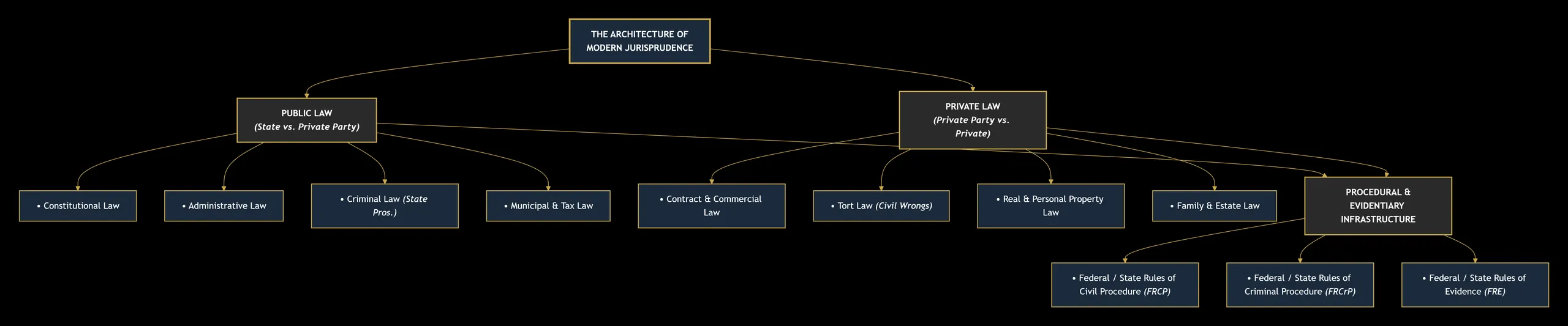
The branches help us organize legal knowledge, but real legal problems routinely cross several branches at once. Understanding their relationships is more important than memorizing their names.
The information provided in this article ("The Major Branches of Law: An Organized Map of the Entire Legal Field") is for general educational and informational purposes only and does not constitute formal legal advice. Reading this content does not create an attorney-client relationship. Laws vary by jurisdiction; consult a licensed attorney for specific legal matters.

Tsvety, LL.M., M.A.
Today’s Quiz
Property Law
10 real questions, free, no account needed. See how well you actually know property law.

Free This Week
Open this week’s Legal Concept Presentation
A downloadable, branded slide deck explaining one key legal term in depth — free every week, the full library included with All-Access.

Interactive Legal Suite
Advance Your Legal Analysis
Explore our interactive decision trees, litigation pipeline builders, and procedural court simulators — designed specifically for law students and practitioners.
Access Interactive Tools →Enjoy The Law To Know?
Tell Google you’d like to see more from us in Search and AI Overviews.
Start small
Try us for a few dollars, or for nothing. No account needed for the first three.
- Free rights card Free
Five sentences to show the police if you are arrested abroad, in many languages.
A whole chapter of black-letter law on one printable page. Free sample.
Inheritance, marriage, children and property in one European country, in one PDF.
72 editable templates: leases, wills, agreements, notices and more.
- Pocket guides $12
Short PDF reference books with closed-book self-checks.
Discussion
Log in to join the discussion.
No comments yet — be the first to add to the discussion.