
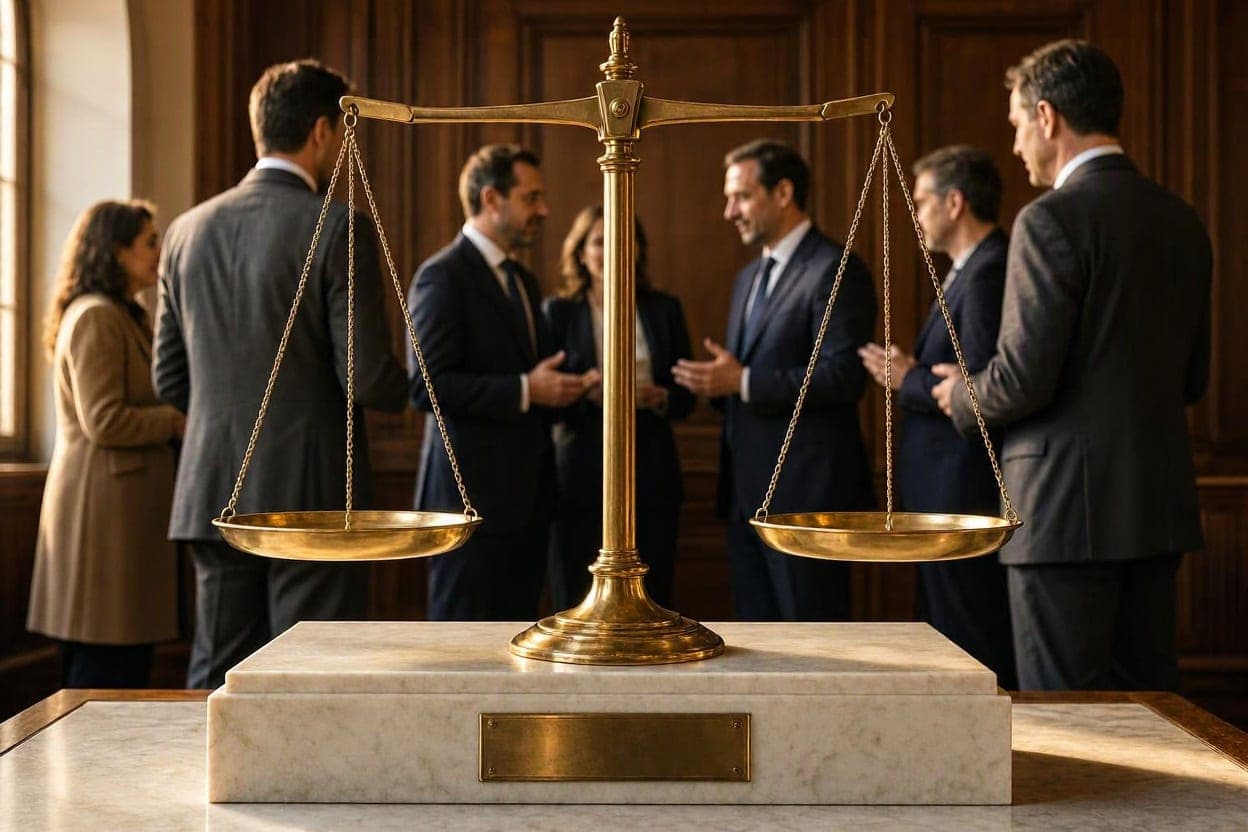
Course · Interpersonal Skills
Cooling the Room
Understand a dispute, lower its temperature, choose the right process and help people reach an ending they can live with.
Pay once, keep it forever · secure payment by Stripe
Lawyers spend their working lives inside other people's conflicts, yet few are taught how conflict works. This course teaches it from the inside: why disputes climb, how to map one before you act, how to lower the temperature in a room or an email, how to hold a hard conversation, how to choose between talking, mediation, arbitration and court, and what fairness asks of you when power, culture and confidence are uneven. Every idea is practised with invented people and rooms that answer back.
The Curriculum
How conflict works: types, escalation and what lawyers add to it→
Four kinds of conflict, the ladder of escalation, and the part a lawyer plays. Practice: Escalation Ladder and Kinds of Conflict.
Mapping a dispute: parties, interests, stories and facts→
Parties and stakeholders, interests, history, power, and separating fact from story from feeling. Practice: Fact, Story or Feeling and Mapping Questions.
De-escalation: lowering the temperature in the room and on the page→
Staying steady, acknowledging feeling, reframing attacks, apologising wisely and writing calm letters. Practice: Reframe It, Your Heat Profile and Calm Reply.
Difficult conversations: starting, staying in and finishing well→
Preparing, opening, staying in, saying no and giving hard news. Practice: Open It Well, Make It Worse and a no-without-a-fight build.
Choosing a process: talking, mediation, arbitration or court→
Direct talks, mediation, arbitration and litigation compared on what matters in the case. Practice: Process Picker.
Mediation for lawyers: the mediator's craft and the advocate's→
The stages of mediation, the mediator's tools, and the advocate's preparation. Practice: Mediator or Advocate and a live mediation.
Power, culture, groups and ethics in conflict work→
Power imbalance, cultural difference, groups and teams, confidentiality and neutrality. Practice: Ethics Flag and a live neighbour mediation.
Capstone: Capstone: a dispute from first call to signed agreement→
A one-page checklist and a full practice mediation of a co-founders' deadlock.
What It Covers
“You will not learn to avoid conflict. You will learn to see it clearly, and to stay useful when it is loudest.”
- Seven modules and a capstone that follow a dispute from the first call to the signed agreement.
- Practice that is more than reading: an escalation ladder, a dispute-mapping lab, a reframing drill, a calm-reply builder, a process picker and an ethics spotter.
- Three full practice mediations (a florist and her landlord, two neighbours, two business partners) in which you are the neutral and the parties' moods change how each move lands.
- Twelve-question quizzes drawn from a pool, a path to a Certificate of Completion, and method that does not depend on one country's law.
Included With All-Access · Or Buy It Alone
Introductory PriceChoose how you unlock Cooling the Room
Subscribe for every course and most tools, or buy just this one course on its own.
The one-time prices below are early, introductory rates for a brand-new catalog — expected to rise as we add more content. Buy now and it’s yours at today’s rate, forever.
Buying a course needs no account: you pay, and we email you a one-click sign-in. Subscriptions need a free account.
Look first, then buy. Free previews on every product page. Secure payment by Stripe. Pay once, keep it forever. Details
Other Scrolls in This Chamber
 Across the Table$15 →Interests, walk-away numbers, offers, trades, pressure tactics and professional limits, with practice rooms and calculators.
 The Client Conversation$15 →Trust, the first meeting, fees and scope, updates in plain words, advice and decisions, bad news, boundaries and ethics, with practice meetings.
 Steady Under Load$15 →Stress, early signals, in-the-moment tools, workload and boundaries, perfectionism, burnout and recovery, with practice labs and a capstone week.
Module 1 is free to try. Sign in, pass each module quiz and the course average, and your Certificate of Completion is emailed to you automatically. This course teaches method and technique with invented people and figures; it is general education, not legal advice, and professional rules differ from country to country.
Common questions
- Is this a mediator-training course?
- No. It is for lawyers and law students who work in or around disputes: as advocates, advisers or occasional neutrals. It teaches the skills mediators use, but it does not qualify you as a mediator, and accreditation rules differ from place to place.
- Does it teach the law of a particular country?
- No. It teaches method. Where processes or ethics rules differ by place, the course says so and tells you to check the rules that apply to you.
- How does it differ from the negotiation course?
- Negotiation is about reaching a deal. This course is about the dispute itself: how it grows, how to understand it, how to cool it, how to choose a process and how to help people through it. The two complement each other, and the practice rooms are different.
- Are the practice mediations scored?
- They give feedback and a debrief, but they are practice. The graded part is the quiz at the end of each module.
- How do I get the Certificate of Completion?
- Sign in, pass each module quiz and keep a course average of at least 75. The certificate is then issued and emailed to you automatically.
- Is any of it legal advice?
- No. The people and disputes are invented for teaching, and this is general education, not legal advice.
Teaching? Share this with your class
Free to use in class. The free parts open for everyone, no account needed.