
 This course explains the law of Canada, not US law. Rules that look the same elsewhere may be different.
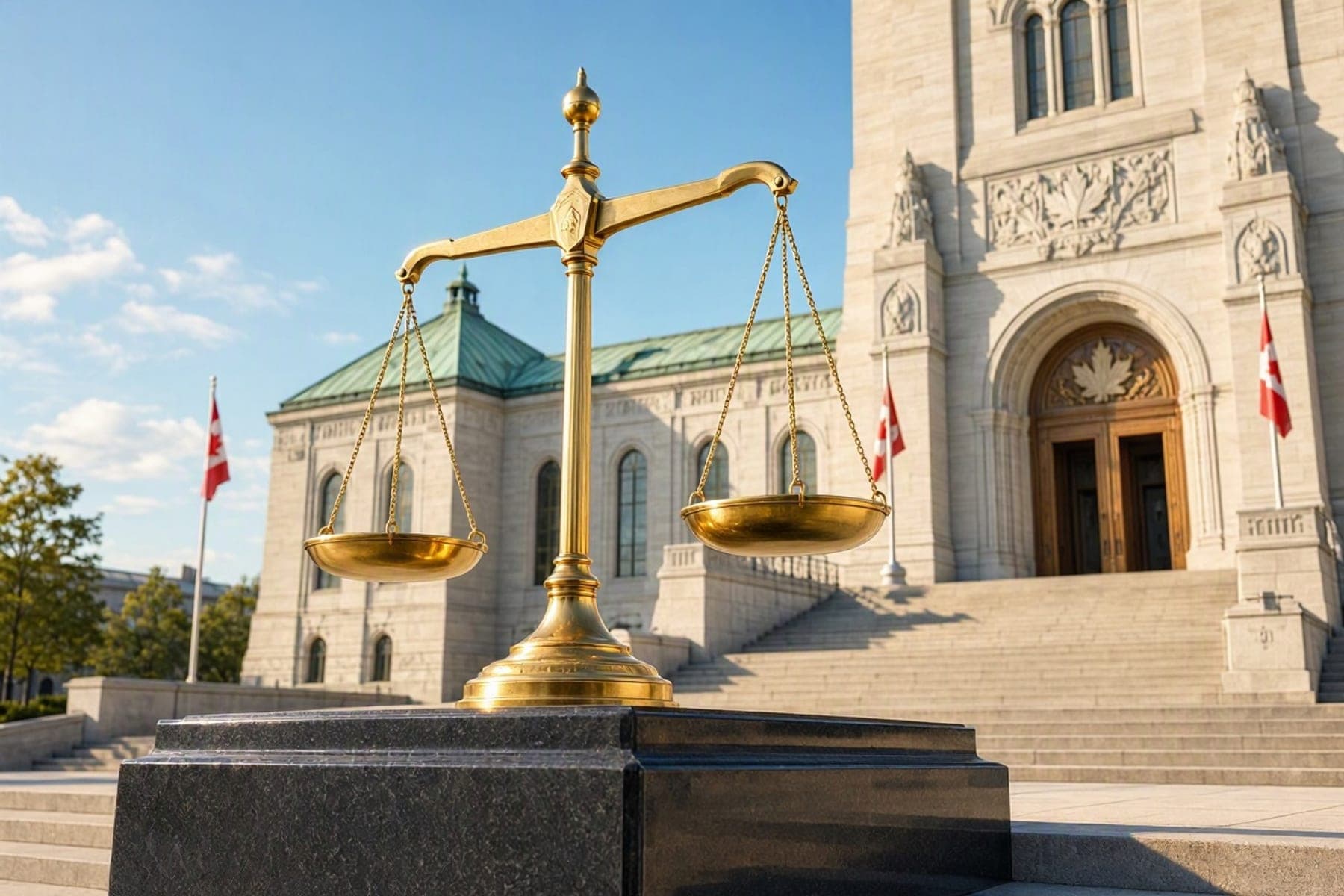
Course · Law by country · Canada
Canadian Law
The law of Canada in one course: the Constitution and federalism, the Charter, equality and Indigenous peoples, courts and administrative law, criminal law and procedure, civil justice, contract and tort, and property, family, work and business.
Pay once, keep it forever · secure payment by Stripe
Canada is a federation with a written Constitution, a Charter of Rights, two official languages and three legal traditions: the common law of nine provinces and three territories, the civil law of Quebec and the legal orders of Indigenous peoples. That mix makes Canadian law distinctive, and it means that nearly every problem starts with a question that most other countries do not ask: which government has the power, and which tradition applies? This course gives a complete first map. It starts with the legal system and the Constitution, then takes federalism and the Charter, equality and the rights of Indigenous peoples, the courts and administrative law, criminal law and procedure, civil justice with contract and tort, and a last module that surveys property, trusts and estates, family law, employment, business, insolvency, consumers, privacy, intellectual property, the environment and immigration. It uses landmark cases that have lasted, invented people and businesses, and three working tools.
The Curriculum
The Canadian legal system and Constitution: traditions, sources, the Constitution Acts, the Crown and Parliament, and languages→
Legal traditions, sources, the Constitution, conventions, the Crown, Parliament and languages. Practice: Which Source, How Is It Amended and Spot the Mistake.
Federalism and the Charter: the division of powers, the reach of the Charter, its rights and limits, and constitutional remedies→
Sections 91 and 92, pith and substance, paramountcy, the Charter’s reach, section 1 and the Oakes test, rights and remedies. Practice: Who Has the Power, Charter Steps and Spot the Mistake.
Equality, human rights and Indigenous peoples: section 15, human rights codes, section 35, the duty to consult and Indigenous legal orders→
Section 15, human rights codes, accommodation, section 35, title, consultation and Indigenous law. Practice: Is It Discrimination, Which Right and Spot the Mistake.
Courts, administrative law and the profession: the court system, the Supreme Court, judicial independence, precedent, judicial review and the law societies→
Court hierarchy, the Supreme Court, independence, precedent, procedural fairness, standards of review, tribunals and law societies. Practice: Which Court, Which Standard and Spot the Mistake.
Criminal law and procedure: the Criminal Code, fault and defences, police powers, bail, disclosure, trial, evidence, sentencing and appeal→
The Criminal Code, fault and defences, search and detention, bail, disclosure, trial, evidence, sentencing and appeals. Practice: Can the Police Do This, Which Rule and Spot the Mistake.
Civil justice, contract and tort: litigation, remedies, class actions, good faith, negligence and the civil law of Quebec→
Courts and limitation periods, procedure, remedies, class actions, contract and good faith, negligence and other torts, and Quebec civil law. Practice: Which Rule, Which Remedy and Spot the Mistake.
Property, family, work and the regulated economy: land, trusts and estates, family law, employment, business, insolvency, consumers, privacy, intellectual property, the environment and immigration→
Land, trusts and estates, family, employment, business, insolvency, consumers, privacy, IP, environment and immigration. Practice: Which Level, Which Rule and Spot the Mistake.
Capstone: Capstone: Nadia Roy and the online craft shop→
An online craft shop, an overlapping licensing law, a two-line refusal, a roadside search, a dismissal and a misleading supplier. Decide the level of government, the standard of review, the Charter steps and the remedy.
What It Covers
“You will be able to say, for any Canadian legal problem, which government has the power, which right or duty applies, which court or tribunal decides it, which standard it uses and what the likely remedy is.”
- Follows the problem: a four-question order of thought (which level of government and which tradition, which right or rule, which court and which standard, and what remedy) that works on every problem in the course and the capstone.
- Teaches the structure behind the rules, so that a student who knows how federalism, the Charter and judicial review fit together can read any new statute or decision.
- Three tools with invented facts: a Division of Powers tool, a Charter Analysis tool and a Standard of Review tool, each showing how the answer changes when a fact does.
- Honest about limits: it teaches durable provisions and landmark cases, treats Quebec’s civil law alongside the common law, and does not state changing figures, fees or recent decisions. It is general education, not advice, and it links to the site’s Canada portal and to NCA Prep.
Included In The Courses & AI Lab Pass · Or Buy It Alone
Introductory PriceChoose how you unlock Canadian Law
Subscribe for every course and most tools, or buy just this one course on its own.
The one-time prices below are early, introductory rates for a brand-new catalog — expected to rise as we add more content. Buy now and it’s yours at today’s rate, forever.
Buying a course needs no account: you pay, and we email you a one-click sign-in. Subscriptions need a free account.
Look first, then buy. Free previews on every product page. Secure payment by Stripe. Pay once, keep it forever. Details
Or give this as a giftOther Scrolls in This Chamber
 Across the Table$15 →Interests, walk-away numbers, offers, trades, pressure tactics and professional limits, with practice rooms and calculators.
 Cooling the Room$15 →How conflict escalates, mapping a dispute, de-escalation, hard conversations, choosing a process, mediation, power, culture and ethics, with practice mediations.
 The Client Conversation$15 →Trust, the first meeting, fees and scope, updates in plain words, advice and decisions, bad news, boundaries and ethics, with practice meetings.
Module 1 is free to try. Sign in, pass each module quiz and the course average, and your Certificate of Completion is emailed to you automatically. This course teaches method and technique with invented people and figures; it is general education, not legal advice, and professional rules differ from country to country.
Common questions
- Does it cover Quebec?
- Yes. It treats Quebec’s civil law alongside the common law wherever the two differ, including contract, civil liability, property, trusts, succession and family law.
- Is this the same as NCA Prep?
- No. This course is a first map of the whole system, with invented cases and working tools. NCA Prep is exam practice for the National Committee on Accreditation’s assessments of foreign-trained lawyers.
- Does it give the current law on every point?
- It teaches the provisions and landmark cases that have lasted. Provincial rules, fees, thresholds and recent decisions change and differ by province, so check current law for any real matter.
- Are the tools real data?
- No. The tools apply well-known rules in simplified form to invented facts. They show the structure of the answer and cannot decide a case.
- Is it useful for practice or for exams?
- Yes. It covers the core subjects of Canadian legal study at a first-map level, and it is useful for anyone who needs to understand how Canadian law and its courts work.
- How do I get the Certificate of Completion?
- Sign in, pass each module quiz and keep a course average of at least 75. The certificate is then issued and emailed to you automatically.
Teaching? Share this with your class
Free to use in class. The free parts open for everyone, no account needed.